
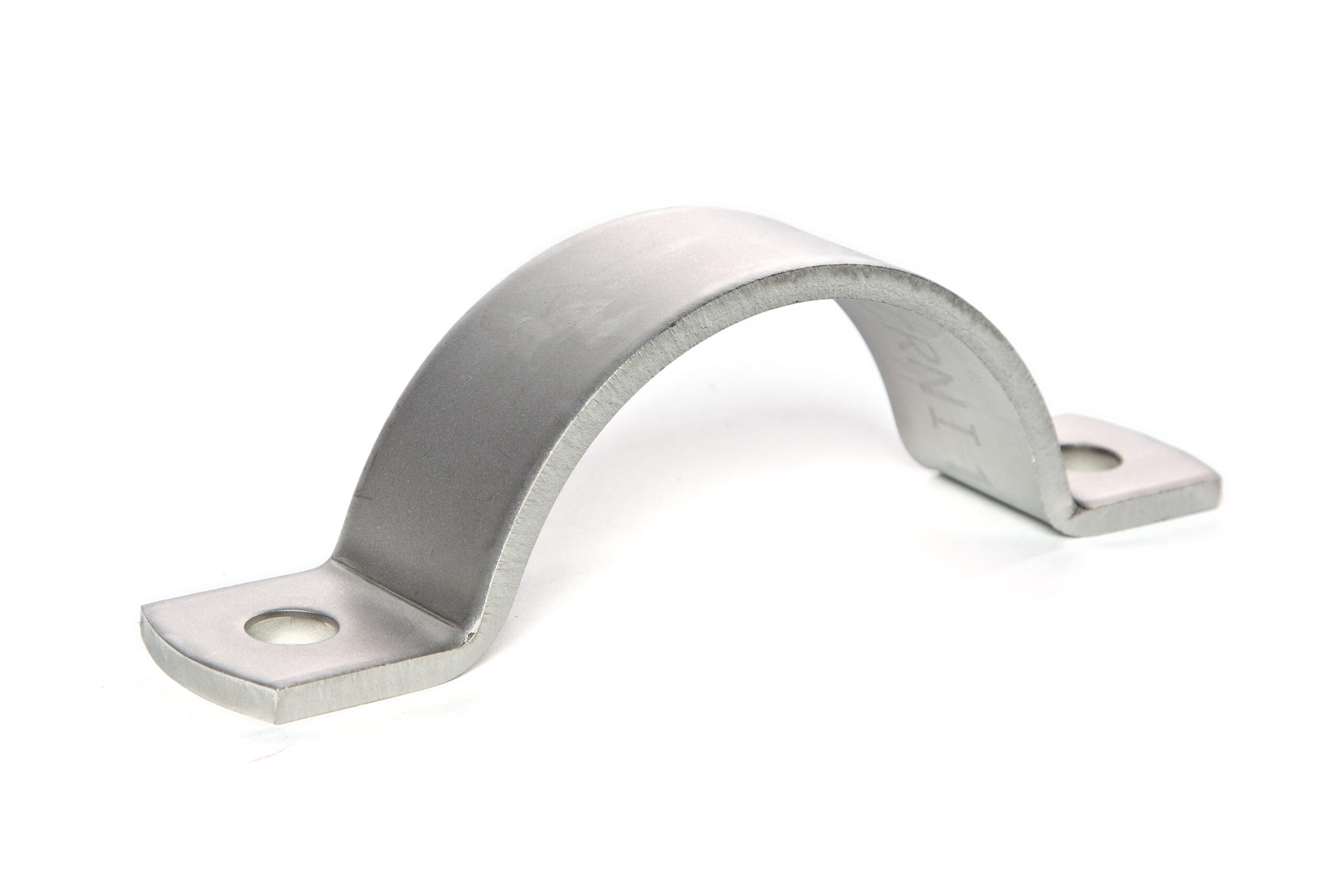
What electropolishing actually does
Electropolishing is an electrochemical process that selectively dissolves the outer 5-25 micrometres of a stainless surface, preferentially attacking the surface peaks and leaving the valleys. The result is a measurably smoother surface with a chromium-enriched passivation layer.
Visually, the surface goes from matte to mirror. Microscopically:
- Surface roughness Ra: typically drops from 0.8 µm (pickled & passivated) to 0.2-0.4 µm.
- Chromium-to-iron ratio: rises from approximately 1.5:1 to 2.5:1 at the surface.
- Free iron content: drops below 1 ppm — passivation test compliant.
The premium over standard pickled-passivated finish is typically 30-50% per clamp. This blog explains when that premium is engineering value and when it is decorative.
When electropolishing is worth it
Pharmaceutical wetted parts (PW, WFI, bioprocess). USP and ASME BPE require validated surface finish on every wetted surface. Although the clamp itself is non-wetted, regulators in 2026 increasingly extend the requirement to wetted-by-design components — and the clamp inner face touching the pipe is interpreted as such on FDA pre-approval inspections.
Cleanroom and semiconductor installations. Semiconductor ultrapure water (UPW) headers and gas distribution panels operate at sub-ppb contamination tolerance. Any surface roughness above Ra 0.4 µm is a particulate generator. Electropolished clamps are mandatory.
Aggressive CIP service. Continuous high-temperature caustic (5% NaOH at 90 °C) attacks pickled-passivated surfaces faster than electropolished surfaces. The chromium-rich EP layer slows corrosion by approximately 30%, extending clamp body lifetime from 15 years to 20+ years.
Marine and chloride-rich environments. EP reduces chloride pitting initiation by approximately 25%. Combined with the right grade (316L or duplex), EP extends marine lifetime significantly.
When it's just decoration
Indoor dry utility supports. HVAC, freshwater, compressed air — pickled-passivated 304 or 316L lasts indefinitely. Electropolishing adds cost without measurable lifetime benefit.
Food-grade installations with EPDM liner. The liner protects the clamping face from product contact. The surface finish of the metal underneath the liner is irrelevant to cleaning effectiveness.
Brewery whirlpool and dairy CIP. Standard pickled-passivated 316L survives 20+ years of daily caustic + weekly acid. The EP premium is recovered only if you push to 25+ year design life.
Marketing-driven specs. "Mirror finish" sometimes appears in tender documents without engineering rationale. Push back at the technical clarification stage — ask what surface roughness number is required and on which surface.
The Ra number game
Several common misunderstandings about Ra:
- Ra is arithmetic mean roughness over a sampling length. It does not capture single deep scratches or local peaks — those are characterised by Rmax or Rt.
- Ra ≤ 0.4 µm is the standard EP specification. Ra ≤ 0.25 µm is a higher-tier finish requiring extended EP cycles, costs ~70% more.
- Visual mirror finish does not equal Ra ≤ 0.4 µm. Buffing can produce a mirror reflection at Ra 0.8 µm. Always require profilometer measurement with the certificate.
The two-stage EP process
NIBRO's EP process is two-stage:
- Acid pickle: removes mill scale and surface contamination. Brings the surface to Ra 0.5-0.7 µm baseline.
- Electrolytic finish: electrochemical bath at controlled current density, removes the top 10-20 µm, lowers Ra to ≤ 0.4 µm.
The two stages together cost approximately 35% over standard pickled-passivated, and 50% over the lowest-cost mill finish. NIBRO performs both stages in-house at our Oisterwijk facility.
Documentation per batch
EP clamps for pharma and semiconductor applications ship with:
- EN 10204 3.1 material certificate (per batch).
- Surface roughness report — profilometer reading on a sample piece, traceable to ISO 21920.
- Free iron test per ASTM A380.
- Optional: USP Class VI compliance, particulate count, extractable test.
Conclusion
Electropolishing is a real engineering treatment with measurable surface improvements — but only some installations need it. Pharma, semiconductor, aggressive CIP and marine justify the premium. Standard food, brewery, dairy and dry utility do not. Specify EP where it earns its cost; specify pickled-passivated 316L everywhere else.
Take this article into your next project meeting
Download the full NIBRO-branded whitepaper PDF — printable, A4, with QR back-link.