
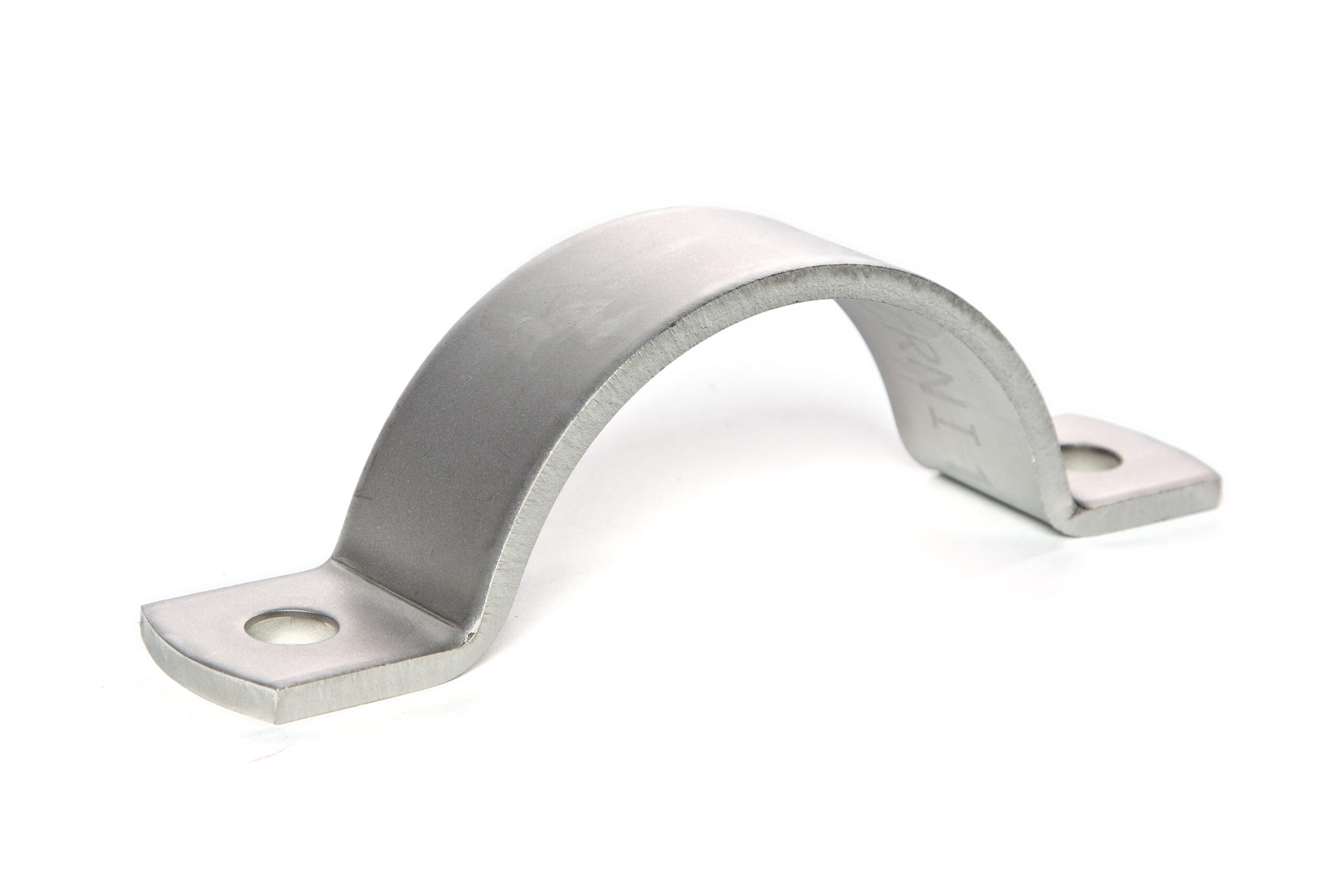
The "stainless 316" supply chain has a problem
The label "AISI 316" on a clamp is a chemistry claim, not a manufacturing claim. The chemistry can be met by multiple producers worldwide using widely varying processes, and the resulting product behaves very differently in service even when the certificate says the same thing.
This is the supply-chain reality behind the price gap between European and Asian stainless clamps. The chemistry numbers match. The mechanical, dimensional, surface and inclusion-content properties do not. And the difference shows up in the field over years, not months.
This blog explains why European stainless production — specifically Dutch and German mills with their downstream forming partners — delivers measurably better clamp performance, and what that means for procurement specifications.
EU mill supply: traceability as a default
European stainless mills — Outokumpu (Sweden/Finland), Aperam (Belgium), Aalborg CSP (Denmark) — operate under regulatory frameworks that mandate full material traceability per EN 10204 3.1 as standard. Each batch is linked to a heat number that traces to the melt date, the alloying record and the conformance certificate.
Asian re-rolled stock often originates from primary mill seconds — material that did not pass the original European mill's QC. The chemistry meets the AISI 316 envelope. The inclusion content, the homogeneity, the surface finish at the strip stage — none of those are within the 3.1 envelope. The buyer cannot tell at the clamp stage because the visible product is the same.
What this means operationally: a NIBRO clamp body manufactured from EU mill stock will pit-resist consistently across batches. A clamp body from re-rolled mill seconds will pit-resist on the certificate-sample piece and fail on the production batch.
CNC tooling: dimensional consistency
The pipe-clamp forming process is a press-tool operation. Two factors determine batch-to-batch dimensional consistency:
-
Tool wear control. Press tooling degrades over time. European manufacturers monitor wear and replace tooling before output drifts beyond specification. Asian producers run tooling to failure, accepting wider tolerance in exchange for higher throughput.
-
Production-batch QC. Each batch is inspected against a reference jig. NIBRO and most European producers scrap out-of-tolerance pieces. Many Asian producers sort, blending in-spec and out-of-spec pieces — the bag delivered to the customer contains both.
The visible operational consequence: a NIBRO clamp installs straight every time. A commodity clamp installs straight some of the time, and the variation appears at random across the batch. The installation crew compensates piece-by-piece, accumulating labour as they go.
EU labour and quality culture
European stainless manufacturing employs skilled, certified press operators and metallurgists working under standardised QC procedures. The cost per worker is higher; the rejection rate is dramatically lower; and the recurring cost of replacement and warranty claims for the customer is correspondingly lower.
Asian commodity production employs lower-cost labour with less metallurgical training. The first-pass yield is similar at the time of inspection but the long-term performance — particularly under cyclic load, cyclic temperature and cyclic chemistry — is measurably worse.
NIBRO has been pressing stainless clamps in Oisterwijk since 2006 using the same press lines and the same QC discipline. Our staff turnover is low; our tooling is fresh; and our customers — including ≥3 of the top 10 European breweries — re-order repeatedly.
Short supply chain: 5-12 days, not 8-12 weeks
A factory in Belgium ordering from a Dutch manufacturer receives stock in 5-12 working days. The same factory ordering from an Asian supplier waits 8-12 weeks plus customs clearance plus port congestion variance.
The economic implications:
- No production stop while waiting for stock. A retrofit project in a brewery cellar that has identified an extra fifty clamps needs them this week, not next quarter.
- No inventory carrying cost. European supply enables JIT ordering against actual project consumption.
- No currency exposure. All quotes in EUR, with European VAT handled in-system.
- No import duties on intra-EU shipments — direct cost saving of 5-12% versus extra-EU imports.
- REACH and RoHS compliance verifiable at the mill, not estimated from imported documentation.
For OEM partnerships and project-based fabrication, the short supply chain is often the decisive factor regardless of price comparison.
Sustainability and carbon footprint
A clamp manufactured in Oisterwijk and delivered to a customer in Hamburg has an embedded carbon footprint dominated by the steel itself (~3 kg CO₂e per kg of stainless), with road transport adding < 2% of the embedded carbon.
The same clamp manufactured in Asia and shipped by sea adds approximately 30-50% to the embedded carbon when port-to-port emissions, last-mile road and customs handling are counted. For operators with CSRD reporting obligations, the difference is material.
EU production also enables:
- Closed-loop scrap recycling through European stainless recyclers (significantly higher recycled content per ton produced)
- Lower per-ton water consumption in the pickling and passivation stages
- Energy from EU renewable grids for the forming and finishing operations
What this means for procurement specifications
For project procurement teams, the European-quality specification translates into the following purchase order language:
- "Material per EN 10204 3.1 traceable to mill heat number, EU mill source"
- "Press-formed clamp body manufactured within the European Union"
- "Batch parallelism ≤ 0.5 mm verified per production lot, calibrated reference jig method"
- "Surface finish Ra ≤ 0.8 µm on clamping face, electropolished available on request"
- "Complete fastener kit A4-70 with DIN 985 nylock nuts, supplied per clamp"
Vendors who can quote against this specification are EU manufacturers with controlled production. Vendors who push back or ask for the price implication are not. The specification is a filter.
NIBRO production at a glance
For procurement reference:
- Facility: Oisterwijk, North Brabant, Netherlands — 4,500 m² production hall
- Operating since: 2006 (twenty years of continuous press production)
- Quality system: ISO 9001:2015 certified
- Production capacity: 3 CNC press lines, in-house pickling and passivation
- Staff: ≥40 across production, engineering, logistics, QC
- Material sourcing: Outokumpu, Aperam, EU re-rollers with full 3.1 traceability
- Standard delivery within EU: 5-12 working days from order
- Customer base: ≥3 of top 10 European breweries, ≥6 long-term OEM partners, food/dairy/pharma/marine fabricators across 22 countries
Conclusion
The price gap between European and imported stainless clamps reflects real differences in material traceability, tooling discipline, QC procedure, supply chain length and embedded carbon. For non-critical applications the gap may not justify the premium. For hygienic, orbital-welded, vibration-loaded or audit-sensitive installations the European specification recovers itself in the first year of operation.
Take this article into your next project meeting
Download the full NIBRO-branded whitepaper PDF — printable, A4, with QR back-link.