The industry is changing — fast
Hygienic stainless piping is in the middle of three convergent shifts: industrial scale (pharma capacity expansion at unprecedented rates), prefab penetration (modular construction replacing field-erected work), and AI-driven manufacturing (computer vision QC, predictive specification, real-time inventory). Each shift changes the role of the pipe support — and the kind of supplier the industry will be buying from in 2030.
This blog covers the four trends most relevant to engineers, OEMs and procurement managers specifying hygienic pipe support systems today, and how NIBRO is positioned to deliver against each one.
Trend 1: Pharma capacity expansion drives demand for documented quality
European pharma investment in biologic, gene-therapy and mRNA capacity has tripled since 2020 and is forecast to keep growing through 2030. Every new line requires hygienic piping. Every fitting and support enters a regulatory chain that traces from mill heat number to installation Q&A.
The implications:
- Material certificates per batch (EN 10204 3.1) become a procurement floor, not a premium option.
- Surface finish documentation (Ra ≤ 0.4 µm for WFI / PW) becomes routine even on non-wetted components.
- Audit trail at the SKU level — every clamp linked to a serial-bagged batch, with the batch tied to a production date and tooling state — becomes a standard buyer requirement.
- CSRD reporting requires per-shipment carbon documentation, which favours short-supply-chain European producers.
Suppliers without the QC and IT infrastructure to deliver this drop out of the bid list. NIBRO has been delivering 3.1 certificates and per-batch dimensional reports since 2008.
Trend 2: Prefab construction replaces field-erection
Modular skid construction has been growing at 8-12% CAGR across food, dairy and pharma. Brownfield expansions and greenfield builds increasingly arrive on site as pre-assembled modules with all piping already mounted, leaving only intermodule connections for field-welding.
For pipe-support supply, this changes the product flow:
- Bulk supply moves from the construction site to the prefab shop. Clamps are no longer ordered per truckload to a remote field office; they arrive at a prefab in 5-12 days against a project BOM.
- JIT delivery against blanket POs replaces speculative stock. A prefab shop running a brewery skid does not store 10,000 clamps — it draws against a NIBRO blanket PO weekly.
- Branded packaging matters more. OEM resellers in skid construction want clamps in their own carton, labelled to their part number, for direct insertion into the prefab work-order.
- EDI / SAP integration becomes mandatory. Manual purchase orders cannot keep up with weekly call-offs across multiple skids. NIBRO supports EDI 850 / 855 / 856 / 810 as standard.
The supplier that wins the prefab business is the one whose IT and logistics integrate seamlessly into the skid builder's MRP — not necessarily the cheapest one.
Trend 3: Cleanroom growth in semiconductor and biotech
Semiconductor fab capacity (especially in Europe, with multiple new fab announcements through 2030) and biotech cleanroom expansion are driving demand for cleanroom-packaged, electropolished, particle-free clamps.
The specification stack:
- 316L electropolished, Ra ≤ 0.4 µm on clamping face
- Degreased to NACA Class 100 (< 5 mg/m² hydrocarbon residue)
- Double-bagged in ESD-safe PE, outer bag wiped at airlock, inner bag opened inside the cleanroom
- Particle count documented per batch (ISO Class 5 equivalent)
- Outgassing characterised per ASTM E595
NIBRO has been supplying cleanroom-packaged clamps since 2014. The volume is growing year-on-year as European fab and biotech capacity comes online.
Trend 4: AI-driven manufacturing and specification
The pipe-support industry is starting to apply machine-vision QC, AI-driven material selection, and predictive demand forecasting. The applications most relevant to specifiers and buyers:
Machine-vision QC at the press. Every clamp passes a camera-based dimensional check before bagging. Out-of-tolerance pieces are auto-rejected. The result: zero-defect outgoing batches and a documented per-piece quality record.
AI material recommendation. Tools like our Pipe Scan AI and AI Engineering Assistant accept project parameters (line chemistry, temperature, pressure, vibration profile) and recommend matched clamp specifications. Specifiers no longer manually cross-reference five different material datasheets to choose a grade.
Predictive inventory. Suppliers run AI-driven forecasting against customer order history to pre-position stock against anticipated demand. The result: shorter lead times even for non-standard sizes, because the forecast model has already triggered the production run before the order arrives.
Computer-vision pipe sizing. Field installers upload a photograph of an existing pipe and the AI returns the OD in millimetres plus the matching DN, inch designation and compatible clamp stock. Our Pipe Scan tool is in production today with hundreds of weekly users.
All four applications are deployed in NIBRO's current production. The next five years will see them become industry standard rather than competitive differentiation.
What this means for procurement decisions made today
For projects specifying pipe supports for installations going live in 2027-2030:
- Specify EN 10204 3.1 per batch as a floor, not a premium. Suppliers who treat it as optional will be priced out within five years.
- Specify European production source if your project carries CSRD reporting obligations or operates under cleanroom audit.
- Specify prefab-compatible packaging (kitted clamp sets with body + liner + fasteners in a single SKU) for OEM-built modules.
- Prefer suppliers with EDI / SAP integration for any long-term blanket-PO arrangement.
- Specify AI-supported sizing tools as part of supplier evaluation — the time saved during design is real.
NIBRO meets all five today. Procurement specifications written against these criteria become future-proof against the next five years of industry evolution.
The long view: stainless clamps in 2030
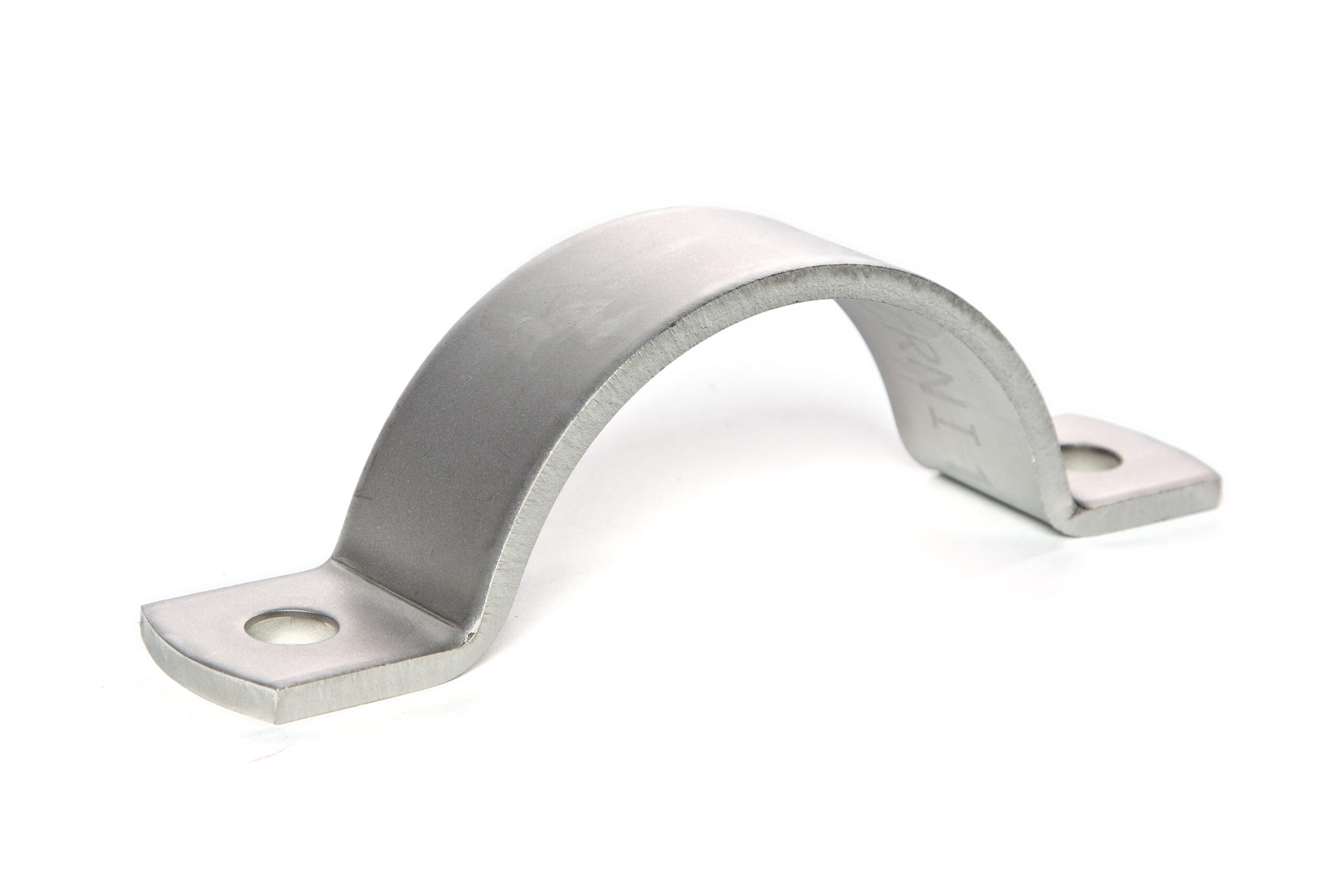
By 2030, the hygienic stainless pipe clamp will look very similar to today's product. The internal radius, the double-bent profile, the EPDM liner and the A4-70 fastener kit will still be recognisable. What will change is everything around the clamp:
- Documented per-piece QC instead of batch QC
- Real-time material certification delivered electronically at point of order
- AI-driven specification integrated into the customer's CAD/BIM workflow
- JIT supply against blanket POs rather than buffer-stock procurement
- Carbon-disclosed shipments with footprint visible at the line-item level
- Cleanroom packaging as a stock SKU, not a custom-order option
NIBRO is investing in each of these areas through ongoing R&D and production-floor upgrades. Our customers in 2030 will receive the same physical clamp they receive today — with a digital and documentation envelope that makes specification, ordering and audit dramatically faster.
Conclusion
Hygienic stainless pipe supports are entering a decade of accelerating change driven by pharma growth, prefab penetration, cleanroom expansion and AI-driven manufacturing. The fundamental engineering of the clamp remains stable. The supply chain, documentation, packaging and specification process around it are being rebuilt. Procurement teams that align with suppliers investing across all four trends will compound efficiency gains year by year — and avoid the dislocation of switching mid-decade.
Take this article into your next project meeting
Download the full NIBRO-branded whitepaper PDF — printable, A4, with QR back-link.