Food factories have a hidden contamination route
Audit teams from FDA, EHEDG and 3-A inspect wetted surfaces. They check tank welds, valve seats, gasket materials. What they rarely flag — and what causes intermittent contamination events nobody can trace — are the pipe supports holding the process lines above the floor.
A pipe clamp is technically a non-wetted component. The process fluid never touches the clamp body. But the clamp environment — the gap between the clamp and the pipe, the rubber liner that contacts the pipe surface, the dead space behind the bolt heads — accumulates condensate, harbours biofilm and contributes to the airborne bacterial load above the production line.
This is why hygienic design extends beyond the wetted path. The clamps holding your dairy pasteuriser line in 2026 are subject to the same scrutiny as the welds inside the pasteuriser.
What makes a clamp "hygienic"
Hygienic clamp design follows the same principles that govern hygienic tanks and valves, scaled down to a few square centimetres:
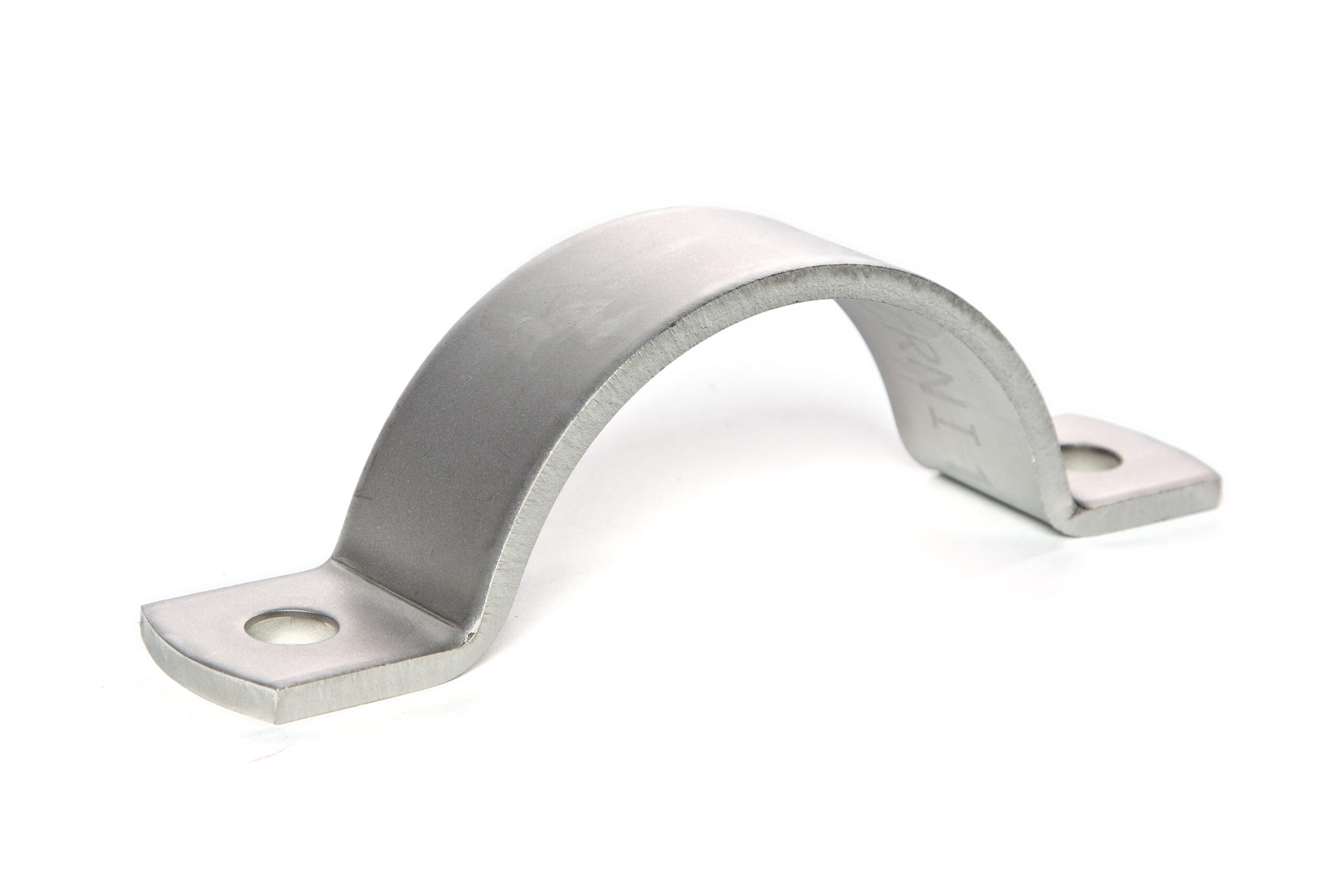
- Smooth radii instead of sharp internal corners. Bacteria colonise the points where two surfaces meet at less than ninety degrees. NIBRO hygienic clamps replace the conventional U-bolt sharp corners with a continuous radius around the clamp inner circumference.
- Drainable geometry. When the production line is washed down, water must drain off the clamp body within seconds. Pooled water on a flat upper surface dries during the next production cycle and concentrates whatever was in the rinse — including residual chemistry that can drift into the airborne environment.
- Crevice-free clamp-to-pipe contact. The interface between the clamp inner face and the pipe outer surface is the single most-likely contamination route. Hygienic clamps use a continuous food-grade EPDM liner that fills the interface and is itself cleanable per CIP.
- Exposed surfaces to CIP fluid flow. The clamp body is sprayed during line-wash. Smooth, accessible surfaces with no shadowed corners allow the spray ball to reach every part of the clamp exterior.
These features are not visual upgrades. They are direct responses to recurring contamination findings documented in EHEDG and 3-A inspection reports across the European food industry over the past two decades.
Material selection for food and beverage
The default material for hygienic stainless piping above DN 25 is AISI 316L (V4A, EN 1.4404) because of its superior resistance to:
- Chlorides in cleaning agents (NaOH/HCl cycles)
- Lactic acid at pasteurisation temperatures (dairy)
- Hop acids and CO₂ (brewery)
- Acidified product (yoghurt, fruit juice, sauces)
304L (V2A, EN 1.4307) is acceptable on dry utility lines and for ambient-temperature water service but is not recommended for any line subject to repeated caustic CIP cycles above 60°C. Pitting initiates at the clamping face within 18-24 months of daily caustic exposure, and the resulting corrosion products contaminate the line directly.
For high-chloride environments (seafood processing, salt-brine lines) we recommend Duplex 1.4462, which offers pitting resistance equivalent to grade 254 SMO at significantly lower cost.
Liner material selection
The rubber liner that contacts the pipe is the second materials decision after the clamp body, and it is often made by default. The right answer depends on your CIP regime:
- White EPDM, 70 Shore A, FDA 21 CFR 177.2600 compliant — the standard food-grade liner. Tolerates 2% NaOH at 80°C for typical 30-minute CIP cycles. Suitable for milk, beer, beverage, sauce.
- Silicone (VMQ) — for higher-temperature cycles (90-95°C continuous, 130°C peak) and for citrus or fruit acid exposure where EPDM ages prematurely.
- PTFE — for chemical service or where any extractives from rubber are unacceptable (infant formula, pharmaceutical-grade food).
- No liner (bare stainless on stainless) — for full CIP/SIP service where the rubber itself would not survive (e.g. 5% NaOH at 90°C). Requires careful surface-finish control to prevent galling.
NIBRO offers all four liner options in stock for the standard hygienic range and on lead-time for custom sizes.
CIP compatibility specifics
The CIP regime determines the clamp specification more than the product specification does. Most hygienic installations run one of three patterns:
Daily caustic at 65-80°C, weekly nitric sanitisation, occasional acid descale. This is the dairy and beverage default. 316L body with white EPDM liner survives 10-15 years before liner replacement.
Daily caustic at 80-95°C, weekly peracetic acid, monthly hot water at 110°C. Brewery whirlpool, pasteuriser circuits and high-temperature dairy. Specify silicone liner; budget for liner replacement at 5-7 years.
Continuous 80°C 2% NaOH (intensive cleaning recycle). Full bare-stainless clamps without liner. Specify electropolished clamping faces to prevent galling.
Be aware that liner failure is silent — the rubber does not visibly degrade until 80-90% of life is consumed. Schedule liner inspection as part of annual shutdown maintenance.
EHEDG and 3-A: what auditors look for
The most common findings related to pipe supports in EHEDG and 3-A audits are:
- Standing water on horizontal clamp surfaces — eliminate by specifying clamps with sloped or radiused tops.
- Visible biofilm at the clamp-pipe interface — eliminate by using continuous EPDM liner rather than gasket strips.
- Corrosion at the clamping face on 304 grade clamps on 316L pipe — eliminate by matching clamp material to pipe material.
- Sharp internal corners on conventional U-bolt supports — replace with hygienic-design double-bent clamps with continuous internal radius.
A facility built with hygienic-design clamps from the start passes these inspection points routinely. Retrofitting commodity clamps to meet hygienic findings during a recertification audit is expensive (full line shutdown, re-validation of cleaning) and rarely cheap.
NIBRO hygienic range
For food and beverage installations, NIBRO supplies:
- 316L (V4A) hygienic clamp sets with continuous EPDM liner, smooth radii, drainable top surface — DN 15 to DN 200
- Matching 316L pipe shoes for sliding pipe-support applications, with Teflon glide pads
- Sanitary saddle clamps for vessel risers (custom OD to vessel skirt)
- Mounting kits with 316L weld plates and A4-70 fasteners
All hygienic-range clamps carry EN 10204 3.1 material certificates. EHEDG-design compliance statements available on request. Standard delivery within Europe: 5-12 working days from order.
Conclusion
Pipe supports in food factories are subject to the same hygienic discipline as the process equipment they hold up. Material grade, liner choice, surface geometry and CIP compatibility all determine whether the clamp accumulates contamination or remains a clean, audit-ready component for the life of the installation. The cost premium of a properly specified hygienic clamp recovers itself the first time you pass an EHEDG audit without remediation.
Take this article into your next project meeting
Download the full NIBRO-branded whitepaper PDF — printable, A4, with QR back-link.