
The gap between the factory and the site
A skid built in a controlled factory environment can pass every Factory Acceptance Test (FAT). The same skid installed on a real plant floor, six months later, can fail the Site Acceptance Test (SAT) for reasons nobody noticed during commissioning.
This blog catalogues the eight most common installation mistakes that survive FAT and surface only at SAT — based on observations from dozens of NIBRO customer audits across European food, dairy, brewery and pharmaceutical installations.
Mistake 1: Final torque not verified after hot cycle
Symptom at SAT: clamp bolts measure 50-60% of nominal torque on inspection at month 2-3.
Root cause: bolts are torqued at factory ambient (20 °C). The pipe heats to 80 °C operating temperature, expands axially, slightly relaxes the clamp grip, and the nylock nut walks back 5-15 degrees under vibration before settling.
Fix: schedule a post-commissioning torque check at 200-400 operating hours. Re-tighten to nominal. Document in the maintenance log.
Mistake 2: Pipe shoes installed without thermal pre-compression
Symptom at SAT: sliding pipe shoes are at the end of their travel after first hot cycle.
Root cause: installers center the pipe in the shoe at ambient. The pipe expands one direction, walks to the edge of the travel, and binds. Cooldown reverses the direction.
Fix: install sliding shoes with the pipe pre-displaced toward the cold-state end of travel — typically 30-40% of total travel, depending on the temperature range. The pipe then walks the full travel during heat-up and returns toward center on cool-down.
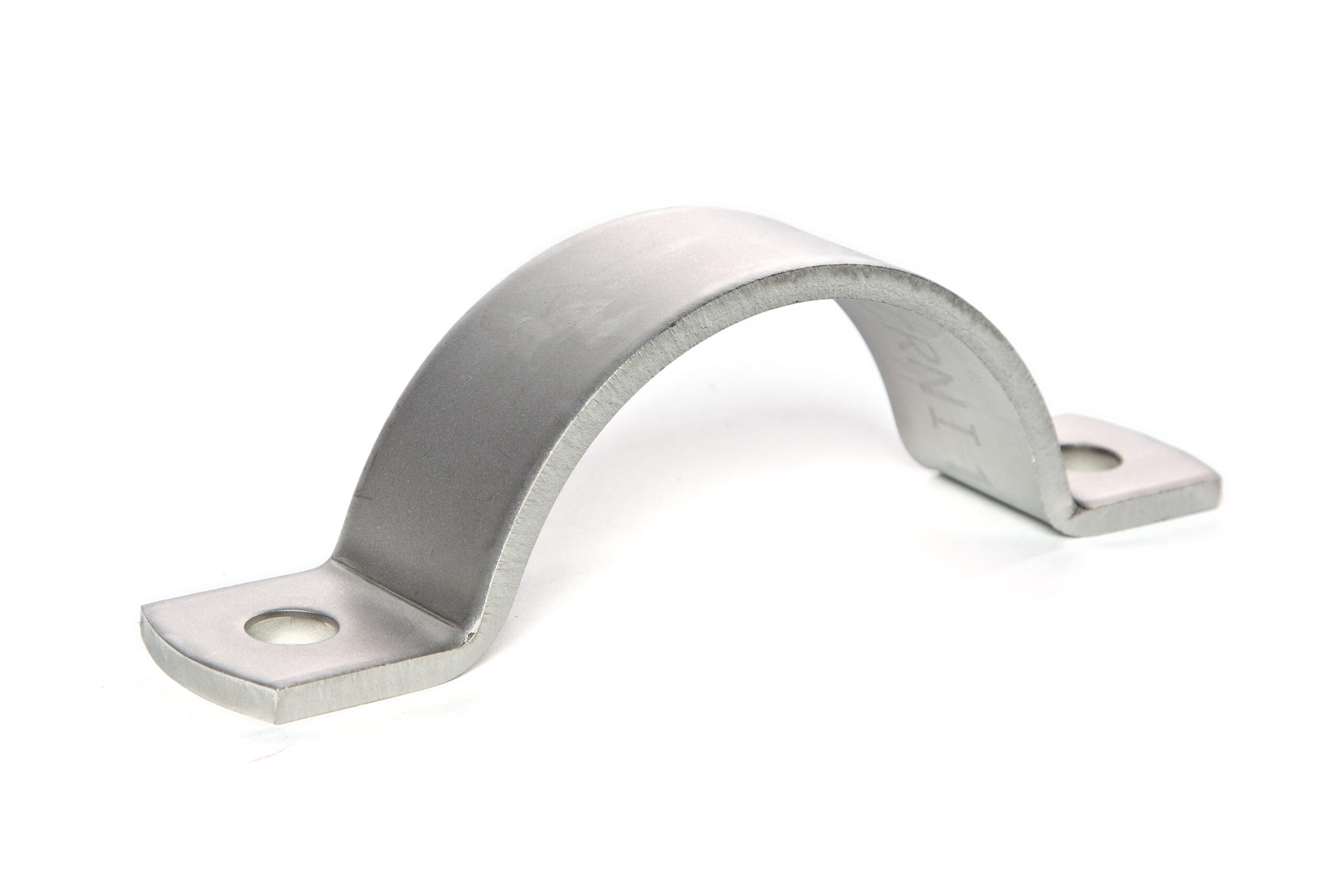
Mistake 3: Half-clamps used as full structural supports
Symptom at SAT: pipe sag exceeds the 0.1% deflection criterion in spans where only half-clamps were installed.
Root cause: prefab shop substitutes half-clamps (1-stuk versions) on spans where the engineering drawing called for full sets, to save labour. Looks fine on visual inspection.
Fix: audit the piece-count of clamps against the drawing at commissioning. Half-clamps and full sets look similar to non-specialists. Train inspectors to distinguish them.
Mistake 4: Mixed-grade clamp bodies on the same line
Symptom at SAT: rust streaks at random clamping faces 6-12 months after commissioning.
Root cause: prefab shop has both 304 and 316L clamps in stock and mixes them on a single line because they look identical. In chloride-containing service the 304 clamps corrode while the 316L stays intact.
Fix: stamp the grade on every clamp at the supplier (NIBRO standard) and audit by visual inspection at commissioning. Replace mixed-grade clamps before energising the line.
Mistake 5: Liners installed wrong-side-out
Symptom at SAT: liner shedding into the line within months, requiring full liner replacement.
Root cause: EPDM liners have a smooth side (designed for pipe contact) and a textured side (designed for clamp body contact). Installation manuals are often ambiguous, and 5-10% of installations end up with the textured side inward.
Fix: pre-fit the liners at the factory with the correct orientation marked. NIBRO ships clamp kits with liners pre-installed where the customer specifies — eliminating this category of error.
Mistake 6: Beam clamps under-torqued because the beam is painted
Symptom at SAT: beam clamps slipping along the beam under vibration, leading to clamp body migration.
Root cause: beam clamp torque is calibrated for clean steel. On a painted beam the paint film acts as a thin lubricant, reducing the friction grip by 30-40%.
Fix: scrape the paint in the contact area before installing beam clamps, or use toothed beam clamps that bite through the paint.
Mistake 7: Threaded rod hangers installed slightly off-vertical
Symptom at SAT: pipe runs visibly tilted at 0.5-1.5 degrees, leading to drainage issues and accumulated CIP residue.
Root cause: threaded rod is suspended from above; installers eyeball the verticality but cannot achieve better than 1° accuracy without a level. Cumulative error across 20 hangers on a 30-metre run produces visible tilt.
Fix: laser-level the rod attachment points during installation. Adjust rod lengths to match. Verify with a calibrated level at commissioning.
Mistake 8: Insulation installed before final torque check
Symptom at SAT: clamp bolts inaccessible for maintenance retorquing — insulation must be cut and re-fitted at every inspection.
Root cause: installation sequence prioritises insulation completion before mechanical commissioning. Once the line is insulated, the bolts are buried.
Fix: complete all mechanical torque verifications before insulation, then install insulation. Add accessible torque ports in the insulation at every 5 clamps for future inspection.
The audit checklist
Before signing FAT, walk the installation with a copy of this list and verify each item:
- [ ] Pre-commissioning torque check scheduled in maintenance plan.
- [ ] Pipe shoes pre-displaced for thermal travel.
- [ ] Half-clamp count matches the drawing.
- [ ] Clamp body grade stamped and audited.
- [ ] Liner orientation pre-fitted at factory.
- [ ] Beam clamp paint scraped or toothed versions used.
- [ ] Rod hangers laser-levelled.
- [ ] Bolt access maintained after insulation.
A typical audit takes 90 minutes per 100 metres of pipe run.
Conclusion
The mistakes above survive FAT because each is invisible at commissioning. They surface 1-12 months later as SAT failures — exactly when remediation is most expensive (full plant shutdown, validated CIP re-qualification, insurance liability questions). Catching them at the FAT walk-down using a structured checklist costs almost nothing. Skipping the walk-down costs everything.
Take this article into your next project meeting
Download the full NIBRO-branded whitepaper PDF — printable, A4, with QR back-link.