
Three ways to hang a pipe
The clamp is only half of the support system. The other half is how the clamp attaches to the building structure: wall plate, beam clamp, or threaded rod hanger. Each has a different load envelope, installation labour profile, and resistance to vibration.
Picking the wrong attachment for the application leads to expensive retrofits 2-3 years into the installation, even when the clamp itself is perfectly specified. This blog walks through the trade-offs.
Wall plate (direct fixation)
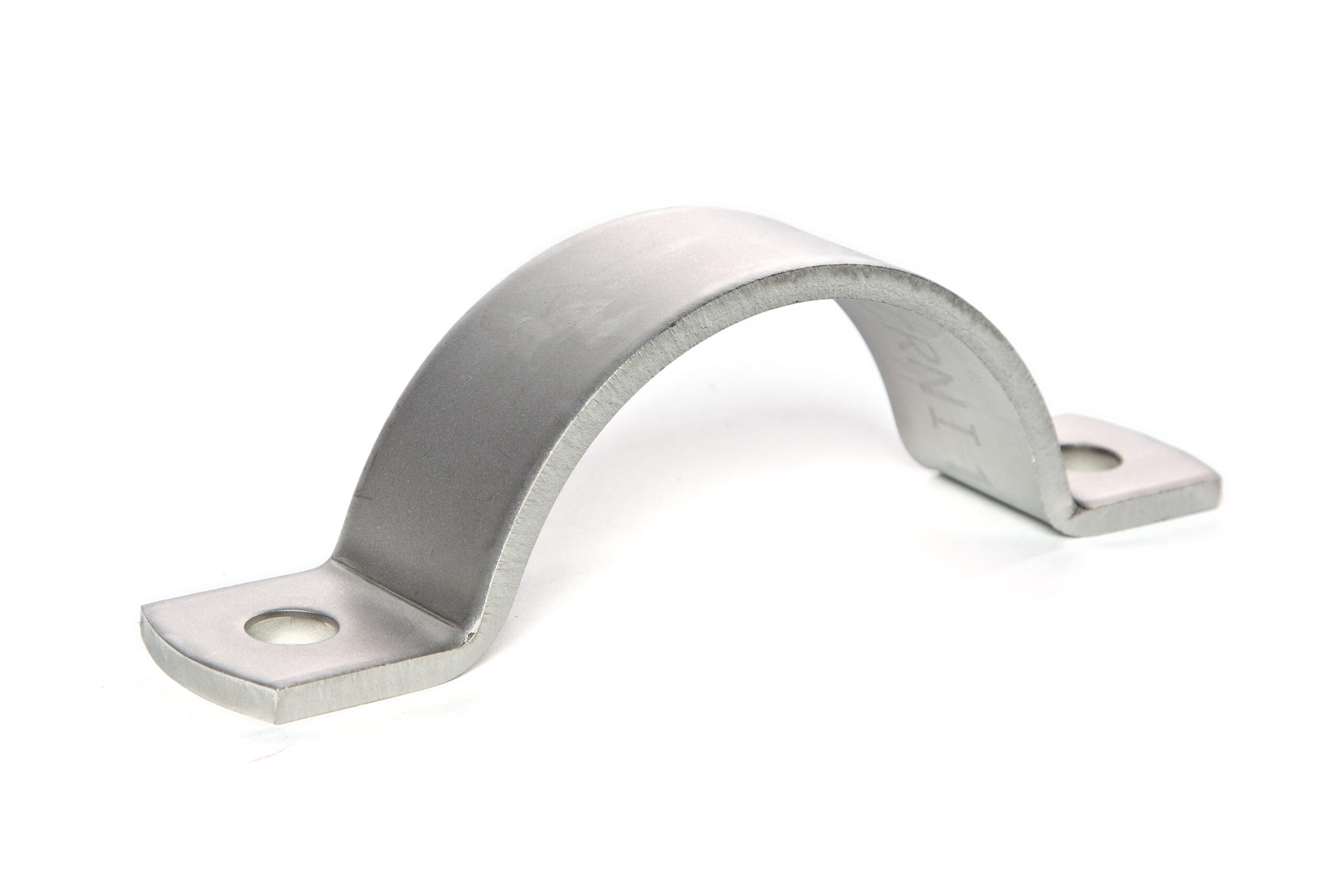
A flat stainless plate bolted or welded directly to a concrete wall, steel beam or equipment skirt.
- Load capacity: 200-2000 kg per fixation, depending on bolt count and substrate.
- Vibration behaviour: excellent — direct rigid connection to building mass.
- Installation labour: medium — requires precise hole drilling and chemical anchor setting on concrete.
- Cost: lowest per fixation.
- Adjustability after installation: none.
Specify wall plates for: pipe runs against walls or columns, high-vibration pump discharge near concrete plinths, permanent installations with no expected re-routing.
Beam clamp
A bolt-on connection to a structural steel beam (typically I-beam or channel), clamping over the flange without drilling.
- Load capacity: 100-1500 kg, limited by the friction grip on the beam.
- Vibration behaviour: medium — the friction grip can loosen under repeated vibration. Use locking versions.
- Installation labour: lowest — no drilling, just torque the bolt.
- Cost: 1.3-1.5× wall plate.
- Adjustability after installation: excellent — slide along the beam to relocate.
Specify beam clamps for: services routed across steel structures, temporary or modifiable installations, projects where final pipe routing is unknown at fixation stage.
Threaded rod hanger
A vertical threaded rod (M8 to M16) suspended from a structural connection above, with the clamp attached at the bottom of the rod.
- Load capacity: 50-800 kg, limited by rod tensile strength and the connection above.
- Vibration behaviour: poor for high frequency, good for low frequency — the rod acts as a soft spring, decoupling the pipe from building vibration.
- Installation labour: highest — requires drilling above for the upper connection and precise rod length cutting.
- Cost: 1.5-2× wall plate.
- Adjustability after installation: excellent — turn the rod nuts to change height.
Specify threaded rod for: long horizontal runs across open ceilings, services needing thermal isolation from building structure, retrofitting on existing buildings without wall access near the pipe.
Vibration considerations
Each fixation type interacts differently with pipe vibration:
- Wall plate: transmits all pipe vibration directly into the building structure. Use only if the building can absorb it without resonance issues.
- Beam clamp: transmits vibration through the beam, with some damping if the beam is large relative to the load. Watch for beam-mounted equipment vibrating in sympathy.
- Threaded rod: acts as a low-frequency isolator (natural frequency 5-15 Hz on typical rod lengths). Good for damping > 50 Hz excitation, poor for sub-5 Hz.
For pump and compressor lines with significant low-frequency content, prefer wall plates or beam clamps over rod hangers.
Thermal isolation
When the pipe is at significantly different temperature than the building structure (cryogenic, hot steam), the attachment becomes a thermal bridge:
- Wall plate: high conduction — full thermal contact between pipe support and building.
- Beam clamp: medium conduction — clamping pad reduces contact area.
- Threaded rod: low conduction — only the rod cross-section conducts heat.
For cryogenic and high-temperature installations, threaded rod hangers are often preferred specifically for thermal isolation, with the rod's softer spring response a secondary benefit.
Combined strategies
Many installations use mixed attachment strategies on the same line:
- Wall plate at the equipment connection (fixed anchor point).
- Beam clamp along straight runs across structural steel.
- Threaded rod through open spans without nearby structure.
NIBRO's catalogue includes matching brackets for all three attachment types, so a single project can mix them without compromising on consistent clamp body and liner choices.
The fastener question
Every attachment type uses different fastening hardware:
- Wall plate: chemical anchor M10/M12 in concrete, structural bolts M12/M16 in steel.
- Beam clamp: integrated A4-70 bolts in beam-clamp body.
- Threaded rod: standard threaded rod A4-70 with two nuts (one above, one below the clamp body).
Always use A4-70 stainless throughout the fastening chain on stainless pipe installations — galvanic mixing at the attachment point is just as damaging as at the clamp-pipe interface.
Conclusion
The attachment strategy determines half of the installation cost and most of the vibration behaviour. Wall plates for rigid permanent fixations, beam clamps for flexibility, rods for thermal isolation or vibration damping. Mix them as the geometry requires, but match the fastener grade across all three to avoid galvanic complications.
Take this article into your next project meeting
Download the full NIBRO-branded whitepaper PDF — printable, A4, with QR back-link.