
The 1% deflection rule
The standard engineering criterion for pipe support spacing is maximum deflection of 0.1% of the span between supports under fully-loaded conditions (water-filled, insulated where applicable). For a 3-metre span, that means 3 mm of mid-span sag.
Below 0.1%, the pipe is structurally calm, joints don't fatigue, and orbital welding heads track without re-centering. Above 0.1%, the sag becomes visible, water pools, and the line eventually fails inspection.
This blog gives you the span tables we use internally — derived from ASME B31.3 with a 2.0× safety factor for hygienic and food-grade installations.
What goes into the span calculation
Three loads accumulate per metre of pipe:
- Pipe self-weight: stainless steel density 8000 kg/m³ × wall thickness × circumference.
- Fluid weight: water (1000 kg/m³) for water service, product density for other fluids.
- Insulation weight: typical rockwool 100 kg/m³ × insulation cross-section.
The maximum allowable span is then:
L_max = (384 × E × I × δ / 5w)^(1/4)
Where E is Young's modulus (200 GPa for 316L), I is the second moment of area of the pipe cross-section, δ is the allowable deflection (0.001 × L), and w is the linear load (N/m).
You do not need to do this calculation per project. The tables below cover 95% of common configurations.
Span table: water-filled stainless 316L tube
| DN | OD (mm) | Wall (mm) | Empty (m) | Water-filled (m) | Insulated (m) | |---|---|---|---|---|---| | 15 | 21.3 | 2.0 | 2.4 | 2.0 | 1.8 | | 25 | 33.7 | 2.0 | 2.8 | 2.4 | 2.1 | | 40 | 48.3 | 2.0 | 3.2 | 2.7 | 2.4 | | 50 | 60.3 | 2.0 | 3.5 | 3.0 | 2.6 | | 80 | 88.9 | 2.3 | 4.2 | 3.6 | 3.1 | | 100 | 114.3 | 2.3 | 4.7 | 4.0 | 3.4 | | 150 | 168.3 | 2.6 | 5.6 | 4.8 | 4.1 | | 200 | 219.1 | 2.9 | 6.4 | 5.4 | 4.6 |
Insulated assumes 50 mm rockwool jacket. Reduce by 10% for 100 mm jacket.
When to override the table
The table assumes typical configuration. Override it when:
- Heavy product: dense liquids (>1500 kg/m³) such as concentrated chemicals or slurry — reduce spans by 25%.
- High-vibration: pump discharge or compressor lines — reduce spans by 30% and use two-bolt damped clamps.
- Thermal cycling: lines with > 100 °C temperature swing — span unchanged, but include sliding shoes per the thermal expansion blog.
- Cryogenic: insulation typically increases, plus 316L stiffness is roughly unchanged so use the insulated column directly.
- Vertical runs: every 1.5× horizontal spacing, with one fixed point at the top of the run.
Half-clamp installations
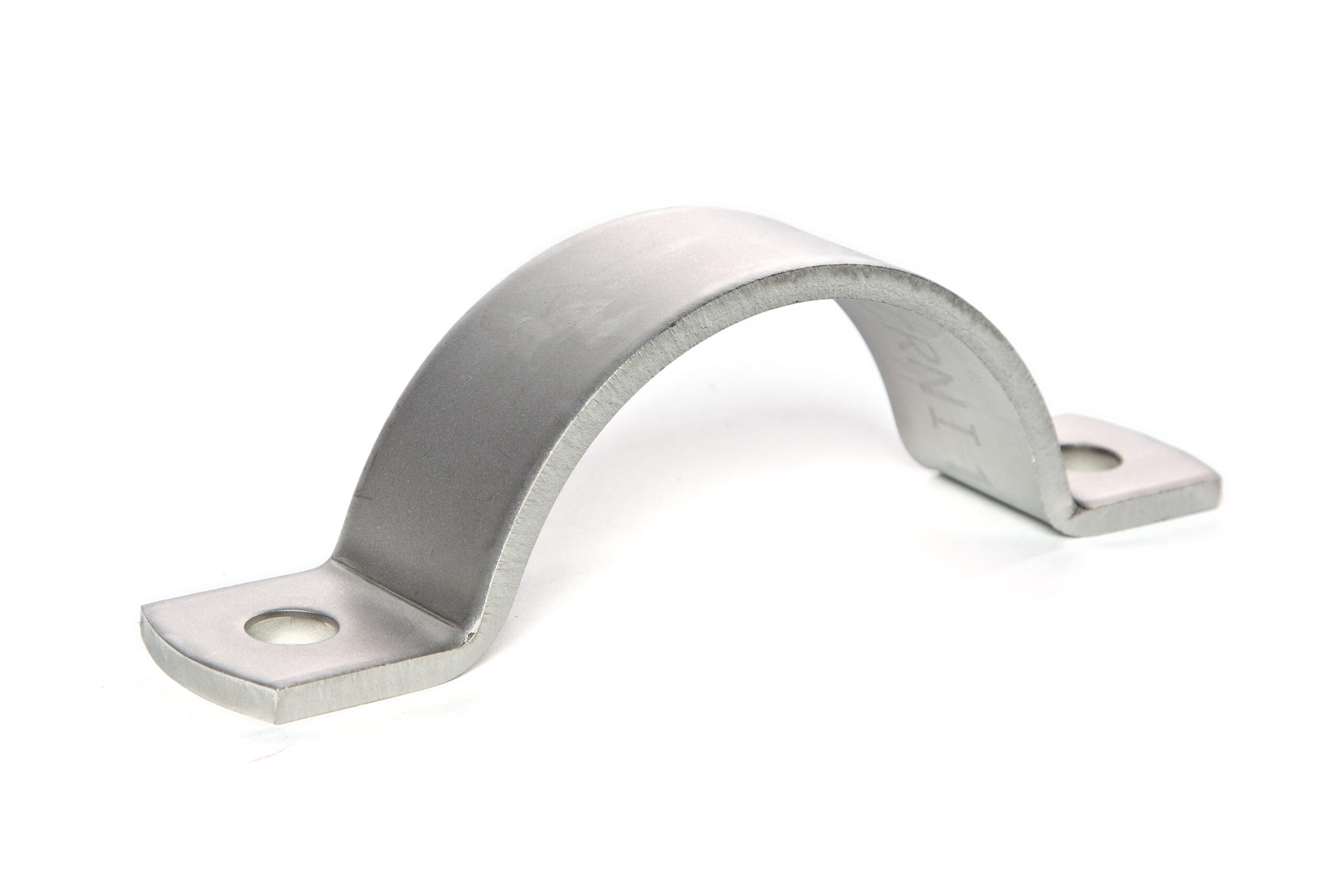
The span tables assume full clamp sets (upper + lower with two-bolt attachment). For half-clamps (a single saddle bolted to a surface, the pipe resting on top), reduce the span by 35-40% — the half-clamp constrains only vertically, not laterally, and the pipe is free to deflect sideways under thermal loads.
NIBRO does not recommend half-clamps for spans above 2 metres on any service.
Field-weld vs prefab spool considerations
A field-welded pipe run can use the standard span table. A prefab spool installation typically uses 15% tighter spacing because:
- The spool sections are heavier (welded flanges, valves, instruments).
- Spool joints carry additional stress concentrations.
- Field-weld fit-up is harder if the pipe is sagging at the support.
For prefab projects, multiply table values by 0.85.
The first and last support
The end supports of a pipe run carry approximately 1.5× the mid-run support load because they bear the pipe end cantilever. Place them closer to the equipment connection (typically 0.5 × standard span from the equipment flange).
Conclusion
Spacing is not a guess — it is a 5-minute calculation against a span table. Use the values above for stainless 316L installations, apply the override factors when conditions justify them, and run a final sanity check against the 0.1% deflection criterion. The cost of one extra clamp is €5-30; the cost of a sagging pipe is at minimum a re-weld and at maximum a contamination event.
Take this article into your next project meeting
Download the full NIBRO-branded whitepaper PDF — printable, A4, with QR back-link.