Orbital welding has zero tolerance for misalignment
Manual TIG welders can shim, re-tack and compensate for a misaligned joint. An orbital welding head cannot. The tungsten electrode tracks a programmed path at a fixed offset from the tube centreline. If the tube wanders inside the clamp, the electrode wanders relative to the joint, and the weld pool reacts: concavity on one side, lack of fusion on the other, occasional burn-through where the gap exceeded the programmed wire feed.
This blog is for fabricators and process engineers who specify orbital welding on stainless piping in pharmaceutical, semiconductor, biotech and high-grade food installations — and who have wondered why their reject rate increases when the supply of fab supports changes.
What the orbital welder needs from the clamp
An orbital welding system controls three variables independently: arc current, travel speed and (on wire-fed models) wire feed rate. It cannot control pipe position. The clamp delivers two things to the orbital operation:
- Concentric grip — the pipe must rotate (or remain stationary while the head rotates) around the geometric centre of the joint. A clamp that grips eccentrically forces the tungsten to traverse a non-circular path relative to the seam.
- Constant offset between adjacent clamps — the two clamps that present the joint to the welder must hold each pipe segment with identical orientation. Any rotation or translation between the two clamps directly shows up as joint misalignment.
In ASME BPE Section MJ for bioprocessing piping, the maximum permissible joint misalignment is 15% of nominal wall thickness or 0.4 mm, whichever is less. On 1.65 mm wall tubing that is a 0.25 mm tolerance window. A clamp with one millimetre out-of-square geometry consumes four times the entire tolerance budget before the welder powers on the equipment.
Why standard clamps fail at this tolerance
Most general-purpose stainless clamps are designed for vibration restraint and dead-load support, not for sub-millimetre positioning. Their design priorities are:
- Cost-effective stamping
- Sufficient grip force after torque
- Corrosion resistance of the body material
None of those goals require sub-millimetre concentricity, so manufacturers do not control for it. The result is a clamp that is mechanically fit for purpose in 95% of installations and silently destroys yield in the remaining 5% — namely the orbital-welded ones.
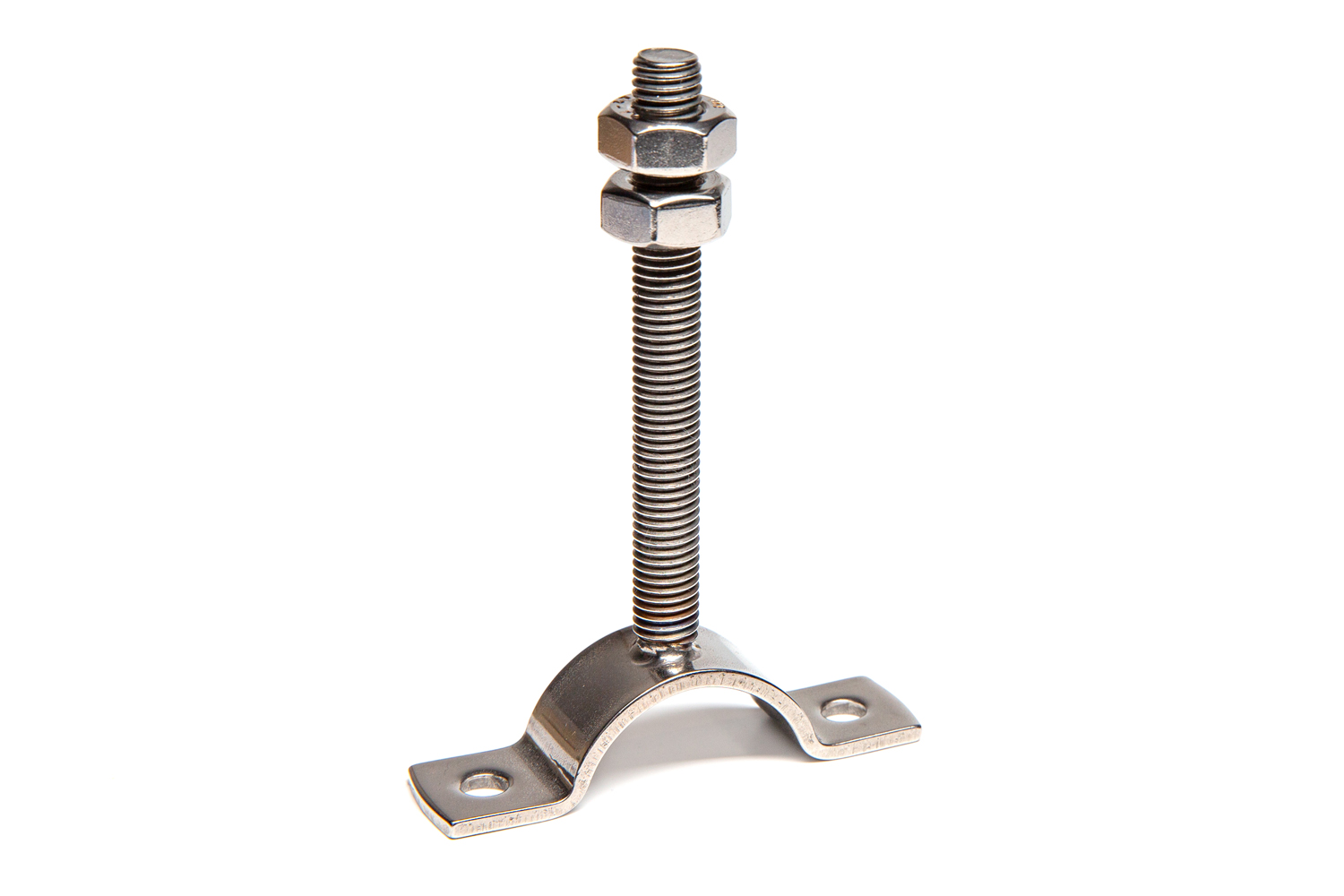
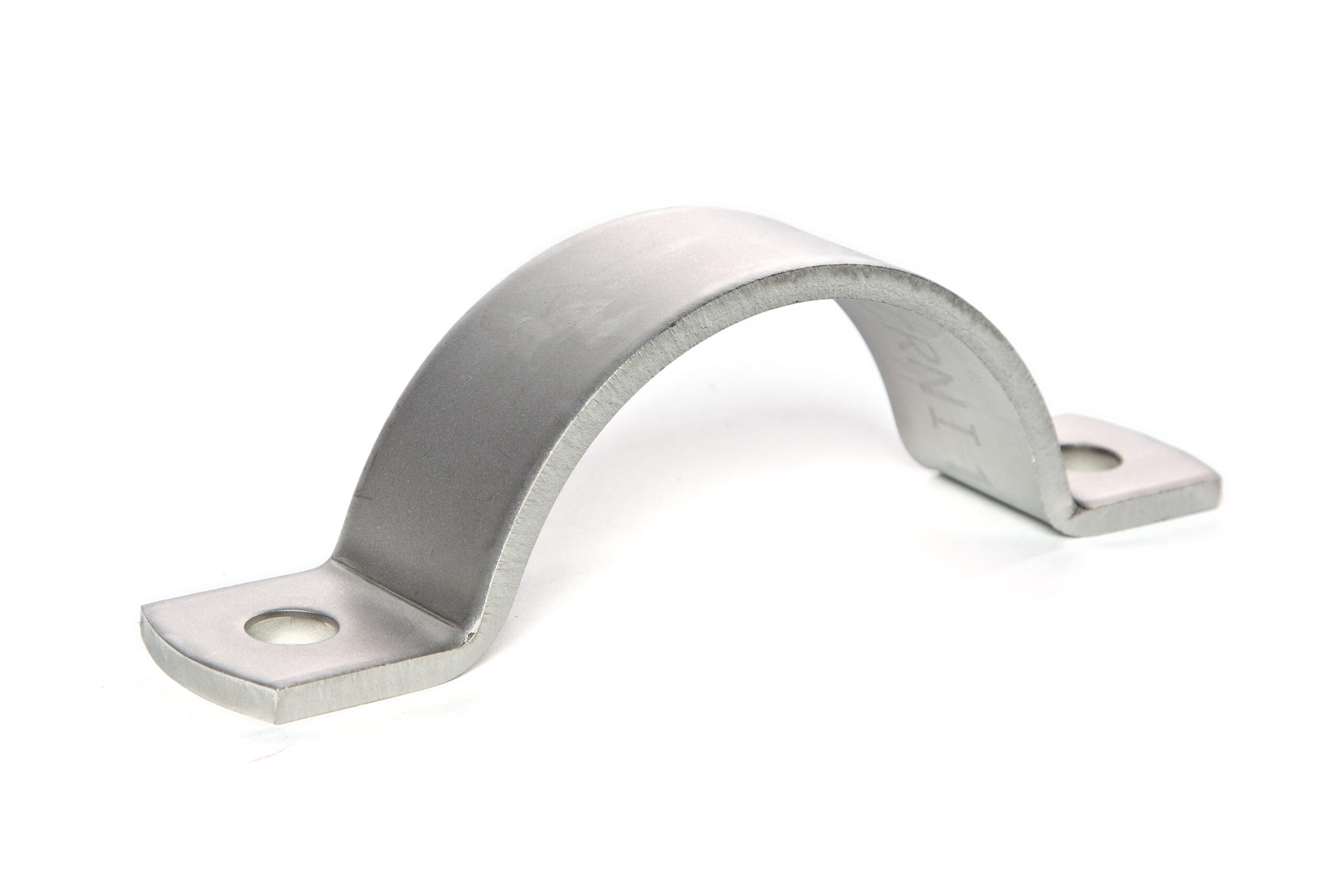
NIBRO precision clamps specify concentricity below 0.2 mm because that is the operating envelope an orbital welding cell needs. The same double-bent profile that delivers straightness across the strip width also delivers concentricity around the clamp axis.
Weld defects directly traceable to clamp geometry
Operators of automatic orbital welding systems consistently report four defect classes that turn out, on root-cause analysis, to be clamp-induced rather than weld-parameter-induced:
Concavity asymmetry. The weld pool sinks more on one side than the other. Procedure adjustment fails because the offset between tungsten and joint shifts as the head rotates — the pipe is not concentric in the clamp. Result: a perfectly tuned program produces unacceptable concavity at the same clock-position on every joint.
Tungsten contamination via short. The tungsten dips into the joint at a specific rotation angle. Operators chase this with arc length adjustments. Root cause: a non-circular clamp inner radius leaves a high spot where the pipe sits closer to the tungsten than the programmed offset assumed.
Inconsistent penetration on the same procedure. The same WPS gives different penetration on different joints. Operators blame material lot variation. Often the real cause is variation in pipe alignment between clamps — some joints present a smaller gap, some a larger one, even at the same programmed wire feed.
Edge wash and burn-through at field-welds. Spool sections fabricated under controlled shop conditions weld perfectly. The same operators, the same procedure, the same machine — and the field-welds between spools show edge-wash. The cause is offset between two installations of clamps from different production batches with different geometric tolerances.
The cleanability connection
Orbital welding's primary commercial driver in hygienic piping is the smooth, full-penetration weld that does not harbour bacteria during CIP cycles. Every defect listed above produces a weld surface that fails cleanability:
- Concavity creates a depression that pools fluid.
- Lack of fusion creates a discontinuity that retains product.
- Edge wash creates a transition that bacteria colonise.
EHEDG and 3-A certification audits inspect for these features. A factory that built its piping on clamps with uncontrolled concentricity will fail surface roughness and continuity checks even though the weld procedure and base material are correct.
NIBRO clamps for orbital applications
For installations requiring orbital welding, NIBRO supplies three specific clamp ranges:
- 316L hygienic pipe clamp sets with white EPDM liner (USP Class VI), concentricity ≤ 0.2 mm, parallelism within 0.1° — used across European bioprocessing fabricators.
- Electropolished sanitary clamps with Ra ≤ 0.4 µm on the inner clamping face, for pharma WFI and PW lines where the clamp inner face contacts validated wetted surfaces.
- Cleanroom-packaged clamps degreased to NACA Class 100, double-bagged in ESD-safe PE for direct introduction into ISO 5 cleanroom space.
All three options ship with EN 10204 3.1 material certificates and dimensional reports per batch. For ASME BPE-conformant projects, dimensional reports include concentricity, parallelism and surface finish on a statistical sample basis.
Specifying clamps for an orbital welding cell
When writing a piping specification for an installation that will be orbital-welded, include the following clamp criteria:
- Concentricity of clamp inner radius to bolt centreline: ≤ 0.2 mm
- Parallelism of clamping faces: ≤ 0.1° from perpendicular to bolt axis
- Material grade: AISI 316L for pharmaceutical and semiconductor; 316L or 304L for food
- Surface finish on clamping face: Ra ≤ 0.8 µm standard, Ra ≤ 0.4 µm electropolished
- Material traceability: EN 10204 3.1 per batch
- Liner material (if applicable): USP Class VI for pharma, FDA-compliant EPDM for food
Suppliers who deliver this spec on time, every batch, are the ones whose installations pass FAT and SAT without rework. The price premium over commodity clamps is recovered on the first weld procedure qualification record.
Conclusion
Orbital welding promises consistent, validated, hygienic joints. It delivers on that promise only when the upstream mechanics are equally consistent — and the most upstream mechanic in any piping installation is the pipe clamp. Specify precision clamps with documented concentricity and you protect every weld parameter that comes downstream.
Take this article into your next project meeting
Download the full NIBRO-branded whitepaper PDF — printable, A4, with QR back-link.