
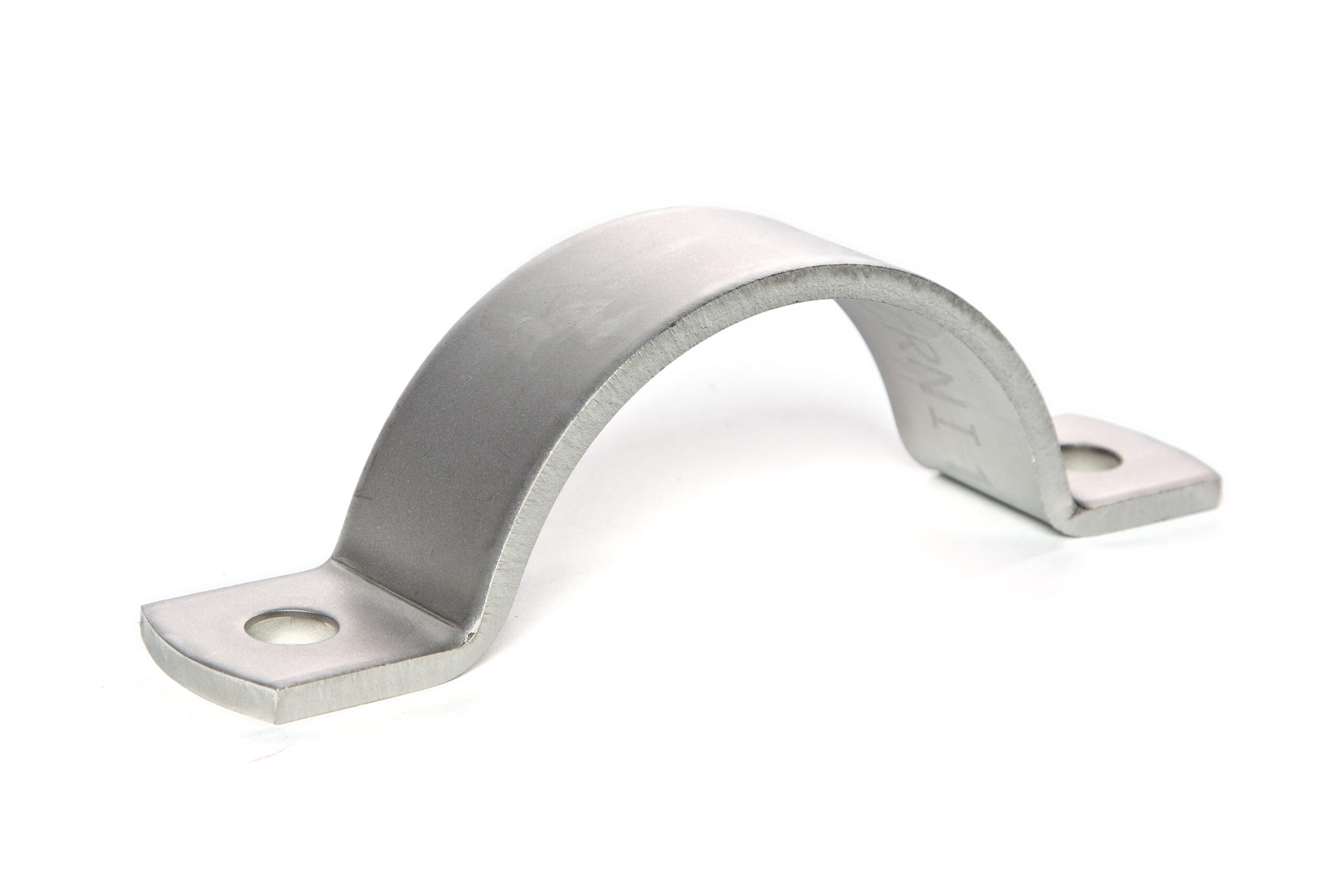
Two industries, one problem: continuous operation with daily CIP
A pharmaceutical plant runs maybe four hours of CIP per day. A chemical plant cleans on a campaign schedule, weeks apart. A brewery and a dairy plant clean every single shift, often twice, and the production lines never see ambient temperature except during the few hours between cleaning and the next product cycle.
This regime — high-temperature caustic and acid alternating with high-viscosity product, 20+ hours per day, 350+ days per year — is the most demanding service envelope in food-grade piping. It is also where the difference between a properly specified pipe clamp and a commodity clamp shows up first.
This blog covers the support-system specifications that survive the brewery and dairy environment, and the specific failure modes that retire under-specified clamps within eight to fourteen months.
The brewery process: zone-by-zone clamp specification
A brewery is not one piping environment but six. The clamp specification differs across the process:
Mash and lauter tun. High starch content, low cleaning frequency, 70-78°C operating temperature. 316L body + EPDM 70 Shore A liner, standard hygienic geometry. Lifetime: 15+ years on the clamp body, 10-12 years on the liner.
Wort kettle and whirlpool. High temperature (95-110°C operating), vortex-induced vibration on transfer lines. 316L body + silicone (VMQ) liner, 2-bolt set with DIN 985 nylock nuts. Vibration causes single-bolt clamps to loosen progressively over 12-18 months; specify two-bolt sets across the entire whirlpool circuit.
Fermenter to bright tank. Aseptic service, intense CIP. Smooth-bore 316L hygienic clamps with USP Class VI EPDM liner, electropolished clamping face Ra ≤ 0.8 µm. The aseptic envelope justifies the higher specification because contamination ingress here ruins entire fermentation batches.
CO₂ recovery. Cryogenic excursions (-30°C) during venting cycles, thermal cycling at 40-50K per cycle. 316L body + sliding pipe shoes to absorb thermal expansion. Rigid clamps without sliding capability transmit cyclic stress to the clamping face and crack within 2-3 years.
CIP and SIP loops. Direct contact with 2-3% NaOH at 80-95°C, peracetic acid at 25°C, sometimes nitric at 60°C. Bare-stainless 316L clamps without rubber liner because no rubber formulation survives continuous service in this regime. Galling-resistant electropolished clamping face required.
Bottling and packaging hall. Lower CIP intensity, mechanical chemicals (cleaning agents), often retrofit installations. 304 grade may be acceptable here for cleaning agent supply lines; specify 316L for any product-contact circuit including bottle-fill.
The dairy process: simpler topology, harsher chemistry
Compared to brewery, dairy has a simpler piping topology — receiving line, pasteuriser, intermediate storage, fill — but a more aggressive chemistry profile. Lactic acid attacks 304-grade stainless at the clamping face within months. Daily caustic at 80°C is the baseline, not the exception.
The dairy specification is therefore narrower:
- 316L throughout (V4A, EN 1.4404). Do not substitute 304 anywhere on the product line.
- White EPDM USP Class VI liner. General-grade EPDM degrades within 18 months under continuous lactic-acid + caustic exposure.
- Two-bolt clamp sets with A4-70 self-locking fasteners. Vibration from positive-displacement milk pumps loosens single-bolt clamps after 200-300 hours of operation.
- Hygienic-design geometry with continuous internal radius. Sharp-corner U-bolt supports accumulate biofilm at the corner-pipe interface and fail audit.
Vibration: the silent destroyer of dairy clamps
The most under-appreciated load case in dairy is positive-displacement-pump-induced vibration. Milk handling uses rotary lobe and circumferential piston pumps that produce a 0.5-2 mm peak-to-peak pulse at the transfer line. The pulse is invisible at ambient temperature but loosens single-bolt clamps progressively.
A loose clamp produces three secondary problems:
- Wear at the liner-pipe interface, depositing rubber particles into the line at the next CIP cycle.
- Galling at the clamping face, generating stainless particulate.
- Pipe-end fretting at field-weld joints, leading to weld-seam crack propagation.
The fix is straightforward: specify two-bolt clamps with self-locking nuts on every line carrying a positive-displacement pump output. NIBRO supplies dairy-specific two-bolt sets as standard on the heavy 30×4 strip range. The cost premium over single-bolt is approximately €2-3 per clamp; the avoided rework cost is at least one order of magnitude higher.
CIP cycle compatibility: what fails when
Both breweries and dairies clean to similar temperature profiles, but with different chemistries. Liner failure modes by chemistry:
- 2-3% NaOH at 80°C, 30-minute cycles, daily. EPDM lifetime 10-15 years, silicone 12-18 years.
- 2% nitric acid at 60°C, weekly. EPDM lifetime 8-12 years, silicone 10-15 years.
- 2% peracetic acid at 25°C, daily. EPDM lifetime 5-8 years, silicone 7-10 years. PTFE liner indefinite.
- 5% NaOH at 90°C continuous (recirculating CIP). Any rubber liner fails within 6-12 months. Specify bare-stainless clamps with electropolished face.
Most installations run a mix. Specify the liner against the harshest cycle in the rotation, not the average.
Maintenance cycles and what to inspect
Plant maintenance schedules tend to inspect clamps annually during the major shutdown. The inspection checklist:
- Visual inspection of clamping face for pitting or galling. Pitting indicates wrong grade for the chemistry; galling indicates loose clamps with vibration.
- Liner integrity check. Press the liner — if it is no longer compliant under thumb pressure, it is at end-of-life.
- Bolt torque verification to manufacturer specification (typically 25-35 Nm for M8, 50-70 Nm for M10 on stainless).
- Drainage check by water spray — any pooled water on the clamp upper surface indicates wrong geometry for hygienic service.
- Pipe-clamp interface inspection by removing the clamp and checking the pipe surface for crevice corrosion or biofilm accumulation.
A properly specified NIBRO installation passes all five checks at year fifteen on the clamp body. The liner may have been replaced once in that period. The bolts and gaskets continue to perform.
NIBRO brewery and dairy stock
Standard stock items for these two industries include:
- 316L two-bolt hygienic clamp sets with USP Class VI EPDM liner, DN 25 to DN 200
- 316L sliding pipe shoes for CO₂ thermal cycling lines
- 316L bare-stainless clamps with electropolished clamping face for CIP/SIP loops
- 316L vessel saddle clamps for fermenter risers and bright tank manifolds
- A4-70 fastener kits including DIN 985 nylock nuts pre-assembled in matched pack
Standard EU delivery: 5-12 working days from order. EHEDG-design statements available on request.
Conclusion
Breweries and dairies operate the most demanding food-grade piping in the industry. Clamp specification must match the harshest cycle in the cleaning rotation, the vibration profile of the pumping system, and the chemistry of the product itself. The labour and product-recall cost of getting it wrong is one to two orders of magnitude above the procurement saving from commodity sourcing. Specify 316L hygienic two-bolt sets, match the liner to the cleaning chemistry, and inspect annually — that is the recipe for installations that last fifteen years and pass every audit in between.
Take this article into your next project meeting
Download the full NIBRO-branded whitepaper PDF — printable, A4, with QR back-link.