
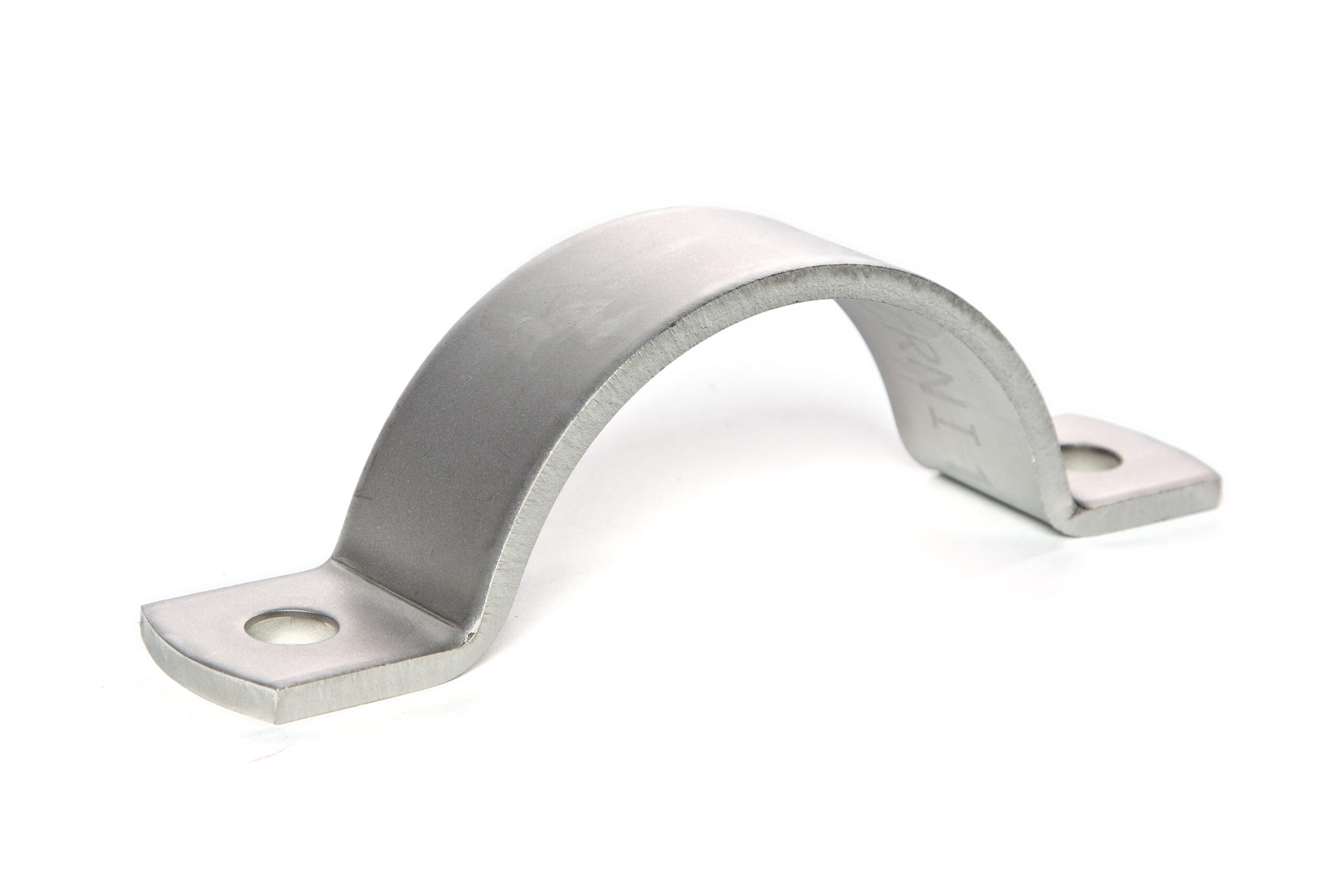
The same family, very different behaviour
AISI 304, 316, 316L and Duplex 1.4462 are all "stainless" in casual conversation. In application they are four very different materials with chloride resistance, mechanical strength and cost varying by factors of 2-4 between them.
Choosing the right grade is not a question of buying the best material — it is a question of matching corrosion resistance to the actual service environment, then accepting the price that comes with it.
This blog is the decision matrix we use internally when quoting custom clamp projects, and the same logic applies to off-the-shelf catalogue ordering.
The three killer questions
Before specifying a grade, answer three questions:
- What is the chloride concentration at the clamping face?
- What is the maximum surface temperature in service?
- What is the cleaning chemistry, and how often?
The combination of those three determines whether 304 will last 20 years or 18 months. Everything else (price, availability, fastener compatibility) is a secondary optimisation.
AISI 304 (V2A, EN 1.4301)
The default European stainless for dry utility and ambient-water service.
- Chromium: 18%. Nickel: 8%. Molybdenum: 0%.
- PRE: 18. Insufficient for any chloride exposure above 50 ppm.
- Service envelope: dry indoor, freshwater, low-temperature steam, food contact (no salt, no acid).
- Lifetime expectation: 25+ years in clean indoor environment.
- Cost: baseline (1.0×).
Specify 304 for: HVAC supports, freshwater distribution, dry compressed-air lines, bottle-fill packaging halls.
Do not specify 304 for: dairy with caustic CIP, brewery, any chloride-containing process, marine applications, swimming pool plant rooms.
AISI 316 / 316L (V4A, EN 1.4401/1.4404)
The default for chloride-exposed and acid-cleaning service.
- Chromium: 17%. Nickel: 10-12%. Molybdenum: 2-3%.
- PRE: 24-26. Adequate for moderate chloride exposure (up to 500 ppm at ambient).
- Service envelope: hygienic food/dairy, brewery CIP, freshwater offshore (splash zone with care), most chemical service.
- Lifetime expectation: 20+ years in dairy and brewery with daily caustic CIP.
- Cost: 1.4× over 304.
316 vs 316L: 316L has lower carbon (0.03% vs 0.08%), avoiding carbide precipitation at weld zones. Always specify 316L for any installation with welding or 60+ °C service. Standard NIBRO clamp range is 316L.
Specify 316L for: dairy, brewery, food, light pharmaceutical, water treatment, ambient marine.
Do not specify 316L for: continuous seawater service, hot brine, swimming pool chemistry, sub-sea offshore.
Duplex 1.4462 (UNS S31803, EN 1.4462)
The high-chloride answer at moderate cost.
- Chromium: 22%. Nickel: 5%. Molybdenum: 3%. Nitrogen: 0.15%.
- PRE: 35. Suitable for continuous seawater up to 50 °C.
- Service envelope: seawater desalination, brine handling, salt-spray manufacturing.
- Lifetime expectation: 12-15 years in seawater splash zone where 316L pits in 18 months.
- Mechanical: yield strength 450 MPa (vs 240 MPa for 316L) — thinner sections possible.
- Cost: 1.6-1.8× over 316L.
Specify Duplex 1.4462 for: salt-spray industries, marine ambient, battery brine, gold-leaching circuits, paper-mill bleach plant.
Do not specify Duplex for: > 90 °C service in chloride (sigma phase precipitation), sub-zero applications below -40 °C without verification.
⚠ Note on swimming-pool installations — ARAMFIX does not supply pipe clamps for swimming-pool plant rooms. Chloramine atmospheres above the pool deck attack every austenitic and most duplex grades through stress-corrosion cracking. For pool plant work, contact info@aramfix.com to discuss titanium or polymer alternatives via custom-order.
Super Duplex 1.4410 (UNS S32750)
For everything Duplex cannot handle.
- Chromium: 25%. Nickel: 7%. Molybdenum: 4%.
- PRE: 41-44. Suitable for hot seawater up to 90 °C.
- Service envelope: offshore topside seawater, subsea umbilicals, sour service per NACE MR0175.
- Mechanical: yield 550 MPa, allows even thinner sections.
- Cost: 2.5-3× over 316L.
Specify Super Duplex for: offshore platform topside, subsea, hot brine evaporators, geothermal high-chloride condensate, sour gas processing.
Selection matrix
| Service | Recommended grade | PRE required | Cost ratio | |---|---|---|---| | HVAC, freshwater | 304 | ≥ 18 | 1.0× | | Dairy, brewery CIP | 316L | ≥ 24 | 1.4× | | Light pharma | 316L EP | ≥ 24 | 1.6× | | Continuous seawater | Duplex 1.4462 | ≥ 35 | 2.2× | | Offshore topside | Super Duplex 1.4410 | ≥ 41 | 3.5× | | Sour service | Super Duplex 1.4410 | ≥ 41 | 3.5× |
The galvanic question
When clamp grade differs from pipe grade, a galvanic potential develops at the contact interface. The general rule: clamp grade should be the same or higher in PRE than the pipe grade. A 304 clamp on a 316L pipe in chloride service galvanically attacks the 304 clamp; the reverse is acceptable.
Conclusion
The choice between 304, 316L, Duplex and Super Duplex is engineered, not negotiated. Run the three killer questions through the matrix above, pick the grade that satisfies the lifetime budget, and let the price difference reflect the corrosion difference. Over-specifying once is cheaper than under-specifying once.
Take this article into your next project meeting
Download the full NIBRO-branded whitepaper PDF — printable, A4, with QR back-link.