
The 16-millimetre problem
A 5-metre stainless steel pipe heated from 20 °C to 200 °C grows by 16 millimetres. Cooled to -40 °C, it shrinks by 5 mm. Across a 30-metre process header, that is nearly 100 mm of total movement between cold start-up and full operating temperature.
If your pipe supports are rigid clamps bolted to a steel beam, that movement has nowhere to go. It is absorbed by the pipe wall as compressive (or tensile) stress, transferred to the welds at the ends of the run, and concentrated wherever the geometry permits — typically at the field-weld between two prefab spool sections.
This blog explains how to size and install sliding pipe shoes that absorb thermal movement without imposing stress on welds, what materials work for which service envelope, and where the most common installation mistakes hide.
The physics in one sentence
Stainless steel has a linear thermal expansion coefficient of approximately 17 × 10⁻⁶ /K for 316L and 16 × 10⁻⁶ /K for 304L. Multiply by length × temperature change and you get displacement:
ΔL = L₀ × α × ΔT
For a 10-metre 316L pipe heated from 20 °C to 150 °C: ΔL = 10,000 × 17 × 10⁻⁶ × 130 = 22 mm.
For a 20-metre cryogenic line going from 20 °C to -196 °C: ΔL = 20,000 × 17 × 10⁻⁶ × -216 = -73 mm contraction.
If the support system cannot accommodate that movement, the energy goes into bending stress at the constrained ends.
Fixed points and sliding points
The standard pattern is:
- One fixed point per pipe run, typically near a piece of heavy equipment (pump, heat exchanger, tank) that defines the anchor of the system.
- Sliding supports between the fixed point and the free end, allowing axial movement while constraining lateral and vertical loads.
A typical 30-metre header has 1 fixed point and 8-12 sliding supports, with one expansion loop or bellows somewhere in the middle to absorb the cumulative growth.
The fixed point holds the pipe absolutely still. Every other support lets the pipe slide axially — but holds it firmly against gravity and against lateral loads.
NIBRO sliding pipe shoe design
A NIBRO sliding pipe shoe consists of three components stacked vertically:
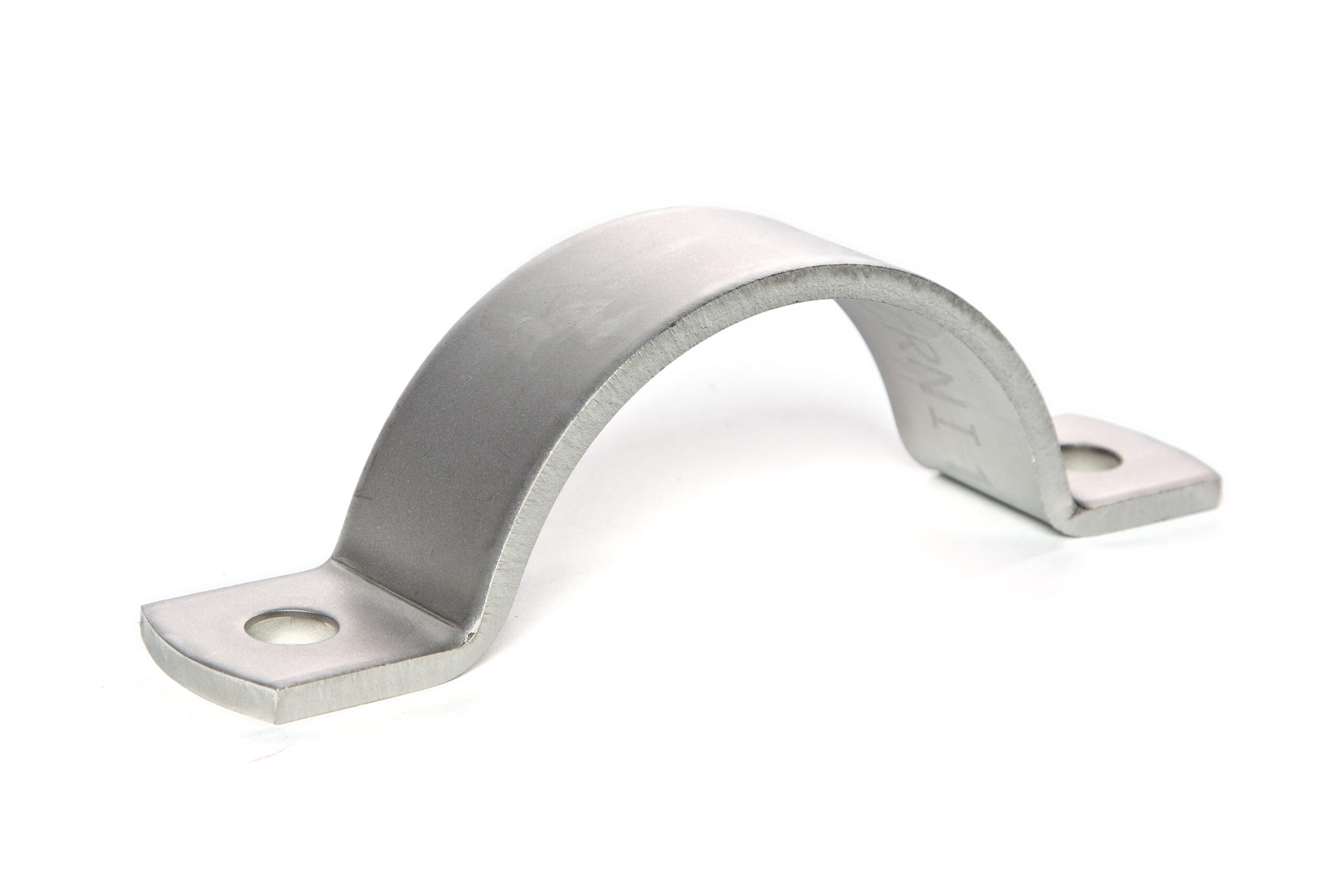
- Upper saddle clamp — grips the pipe outer diameter, transfers vertical and lateral loads downward.
- Glide pad — Teflon (PTFE) up to 250 °C, graphite-impregnated composite above 250 °C. The glide pad has a friction coefficient of 0.05-0.12, which means a 100 kg pipe section needs only 6-12 N of force to slide axially.
- Base mounting plate — bolted or welded to the support beam, with raised edges that constrain lateral movement.
The pipe is free to slide axially through the saddle clamp; it is constrained against lateral movement by the base; it is constrained against rotation by being held firmly enough vertically that friction holds the axis.
What does not work
Several common installation patterns fail under thermal cycling:
- Two rigid clamps on a 5-metre stainless tube. Even at 80 °C the tube grows 6.4 mm. The bolts on the second clamp loosen progressively, or the pipe buckles, or the field weld cracks. We see this on every dairy installation built without thermal review.
- Rubber-lined clamps used as "sliding" supports. The rubber liner does not slide cleanly — it grips, releases, grips again, in a stick-slip pattern that fatigues the pipe wall locally.
- Sliding shoes installed without the glide pad. Stainless-on-stainless dry contact has friction coefficient 0.35-0.5 and galls under axial load. Always install with the appropriate glide pad.
Span and pad sizing
A correctly sized sliding shoe has glide-pad area sufficient to support the static load with surface pressure below 5 N/mm². For typical process tube up to DN 100 with insulation, the standard NIBRO 80 × 80 mm PTFE pad is adequate. For DN 150 and above, we supply 120 × 120 mm pads as standard.
The pad must also be wide enough to accommodate the full thermal stroke without the pipe walking off the edge. Standard NIBRO pads accommodate ±30 mm of axial movement, which covers a 6-metre span at 200 °C. For longer spans or extreme temperature ranges, we supply 200-mm-wide custom pads on lead-time.
The vapour-barrier detail
On cryogenic and chilled-water service, the sliding interface is a thermal bridge — heat conducts through the metal saddle, the glide pad, the support beam, and warms the pipe.
The fix is to wrap the entire sliding shoe assembly with insulation cradles — pre-formed PUR foam blocks that fill the gap between pipe and saddle, plus an outer aluminium vapour barrier that prevents condensation.
NIBRO supplies pre-insulated sliding-shoe assemblies for service from -196 °C to +250 °C, ready for plug-and-play installation.
Conclusion
Sliding pipe shoes are not a luxury detail — they are the only way to support a pipe run that changes temperature. Every NIBRO project quotation for steam, thermal oil, cryogenic or chilled-water service includes a thermal expansion calculation and a sliding-shoe schedule. The five euros spent per metre of run on glide pads is recovered the first time you avoid a re-weld on a stress-cracked spool.
Take this article into your next project meeting
Download the full NIBRO-branded whitepaper PDF — printable, A4, with QR back-link.