
Three classes of vibration
Pump and compressor piping sees three distinct vibration regimes, each requiring a different support approach:
- Low-frequency, low-amplitude: centrifugal pumps, 5-30 Hz, 0.1-0.5 mm displacement. Standard two-bolt clamps with self-locking nuts handle this without modification.
- High-frequency, low-amplitude: positive-displacement (PD) pumps and screw compressors, 30-200 Hz, 0.5-2 mm displacement. Two-bolt clamps with damping liner required.
- Low-frequency, high-amplitude: reciprocating compressors and slurry pumps, 1-10 Hz, 2-20 mm displacement. Spring hangers or pneumatic mounts required.
Choosing the wrong category leads to either rapid fatigue failure (under-engineered) or unnecessary cost (over-engineered).
Standard two-bolt clamps
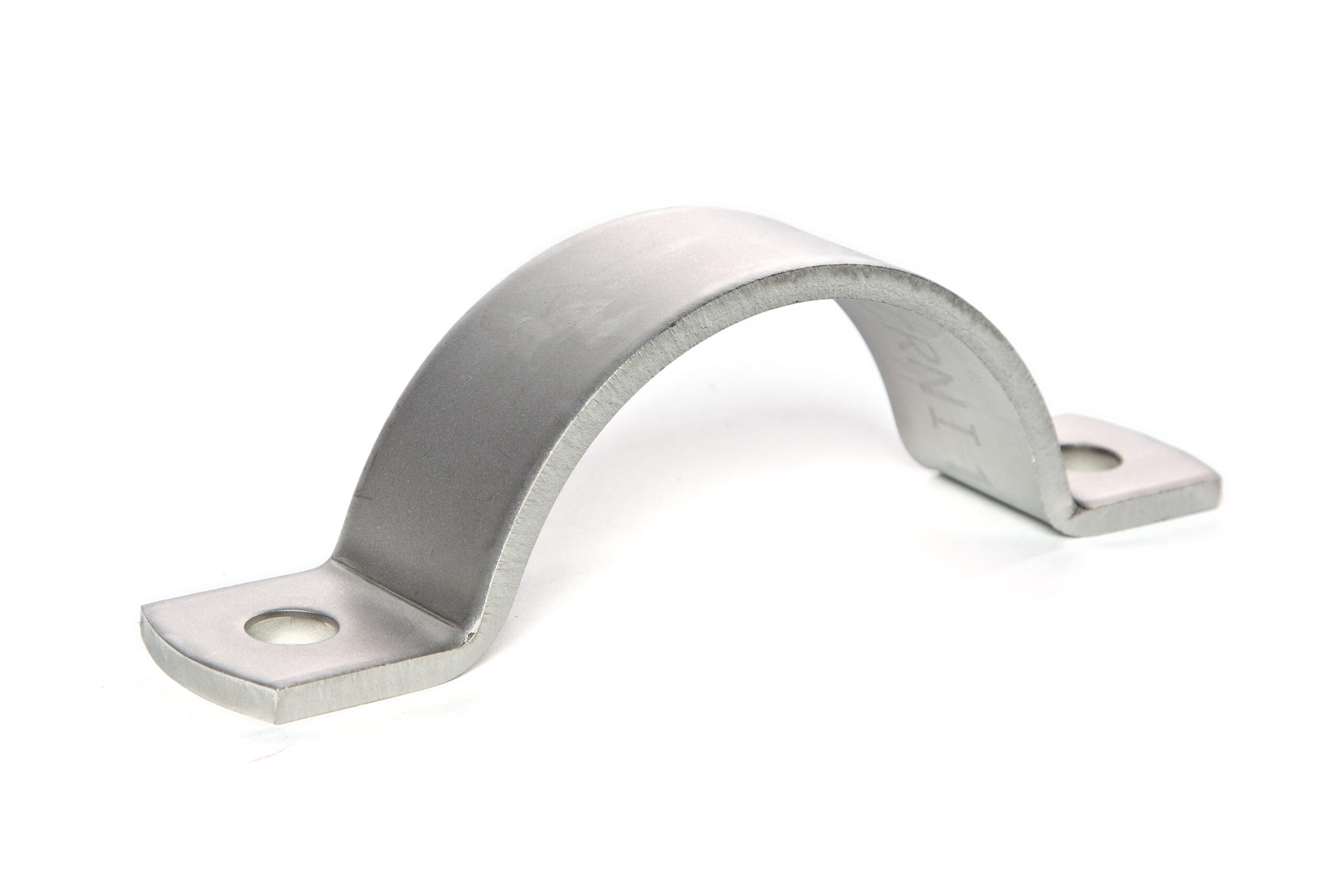
A NIBRO two-bolt clamp with A4-70 self-locking nuts (DIN 985 nylock) and 75 Shore A liner retains > 95% of clamping force after 10⁶ cycles at 4g acceleration. This covers:
- All centrifugal pump discharge lines below 30 kW.
- All booster pumps in HVAC and water distribution.
- All ambient-temperature transfer lines between equipment skids.
Cost premium over single-bolt: approximately €2-3 per clamp.
Damped two-bolt clamps
For PD pump and screw compressor discharge, the standard two-bolt clamp needs damping enhancement:
- 75-85 Shore A silicone liner in place of EPDM.
- Wedge-lock washers between clamp body and mounting plate.
- 4-hole mounting plate for stiffer anchorage to the beam.
The damped configuration handles 200 Hz @ 4g without fastener back-out. Cost premium over standard two-bolt: approximately €1-2 per clamp.
Spring hangers and pneumatic mounts
When pipe displacement exceeds 2 mm, no rigid clamp absorbs the motion without transferring stress to the pipe wall. The solution is a spring hanger or pneumatic mount:
- Variable spring hanger: typical load 50-2000 kg, vertical travel ±50 mm, natural frequency 2-5 Hz.
- Constant-effort spring: maintains pipe support force as the pipe moves through its full travel — used near thermal expansion loops and reciprocating equipment.
- Pneumatic isolator: air-spring mount with 0.5-2 Hz natural frequency, isolates low-frequency excitation from sensitive equipment.
NIBRO does not manufacture spring hangers directly but specifies them in our project engineering quotes when the calculation requires them, paired with our stainless saddle clamps that interface with the spring hardware.
The first-mode resonance trap
The most expensive failures happen at the first natural frequency of the pipe-support system, where excitation from the pump matches the resonant frequency and amplitude grows uncontrollably.
The first natural frequency of a simply supported pipe span is:
f₁ = (π/2L²) × √(EI/ρA)
For a 316L DN 50 pipe spanning 3 metres between supports, f₁ ≈ 25 Hz. If the pump runs at 1450 RPM (24 Hz), you are within 5% of resonance — and the support life will be measured in months.
The fix is to shorten the span or add an intermediate clamp to move the natural frequency above the excitation frequency.
NIBRO project quotations for pump-line installations include the resonance check at no extra cost.
Validation testing
For critical installations we provide validation reports on request:
- Sine sweep 5-200 Hz at 4g — verifies fastener integrity across the operational envelope.
- Random vibration MIL-STD-810G — simulates 25 years of operational service in 24 hours.
- Thermal-cycle combined — verifies behaviour under combined vibration + temperature cycling.
These tests are performed at TÜV Rheinland Netherlands. Test reports available under NDA.
Conclusion
Pump and compressor piping fails at the supports, not at the pipe. Choose support hardware that matches the vibration class — two-bolt for low-frequency centrifugal, damped two-bolt for PD and compressor, spring hangers for reciprocating. Run the first-mode resonance check at engineering stage and you save a 50% maintenance budget over the installation lifetime.
Take this article into your next project meeting
Download the full NIBRO-branded whitepaper PDF — printable, A4, with QR back-link.