
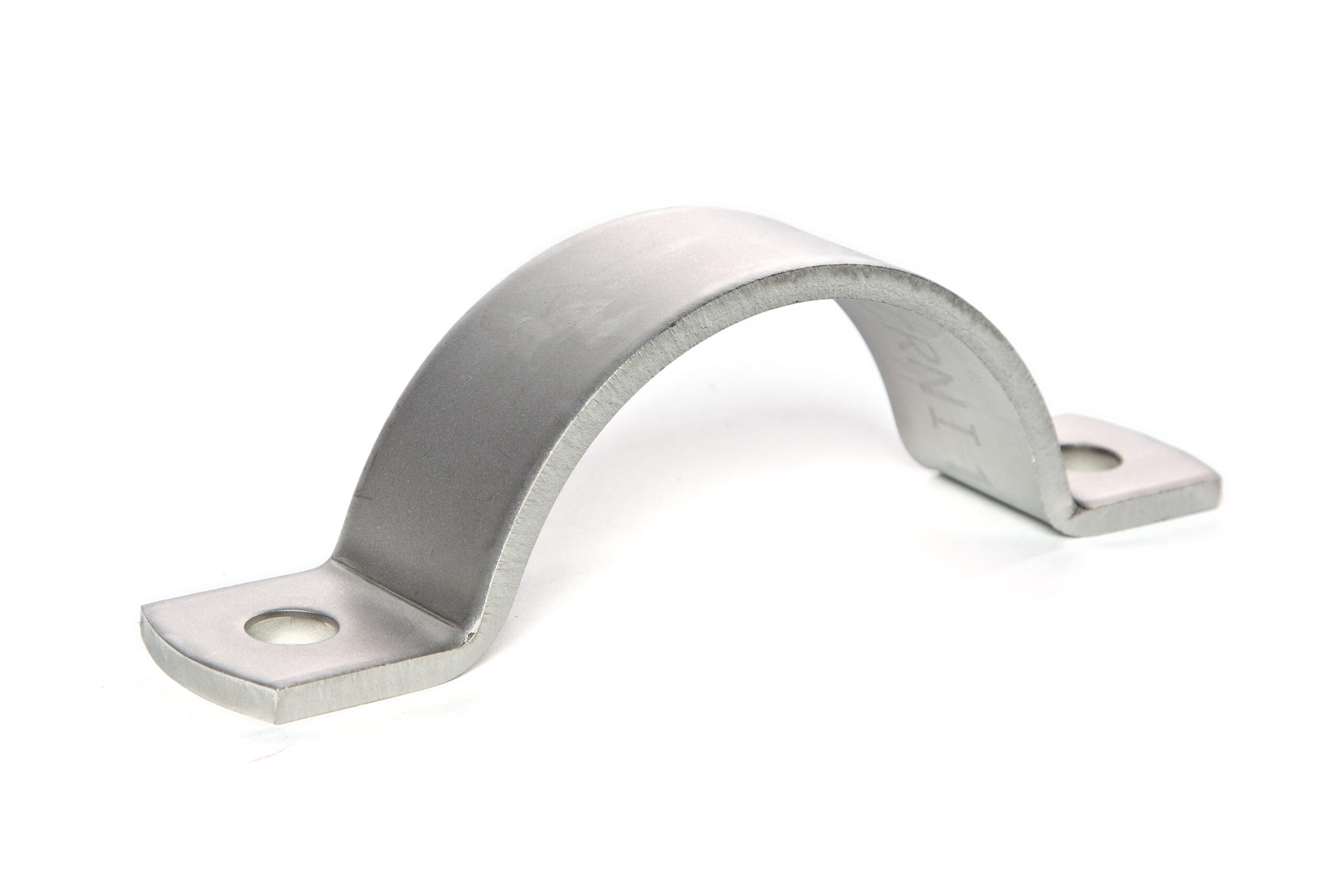
The hidden cost of a 1 millimetre deviation
Most factory installations begin with a deceptively simple component: the pipe support. A stainless tube run between a pump and a heat exchanger may carry hundreds of thousands of euros of process fluid per day, yet the bracket that holds it costs five euros and looks unremarkable.
That five-euro clamp determines whether your welders spend 90 seconds or four minutes on every joint.
A one millimetre out-of-square deviation at the clamping face becomes a five millimetre pipe deviation across a three-metre span — basic trigonometry that prefab shops re-discover the hard way every Monday morning. Multiply across two hundred supports on a typical brewery process line and your installation crew loses two full shifts to shimming, re-tacking and grinding.
This blog explains why pipe-clamp straightness is not a luxury specification but the single highest-leverage decision in stainless installation economics, and what the NIBRO double-bent profile does to eliminate the problem at source.
What "straight" actually means in a clamping context
In a metallurgically correct pipe support, four geometric conditions must hold simultaneously:
- Parallelism between the upper and lower clamping faces. If the faces close at an angle, the clamp grips the pipe at two lines rather than around the full circumference, concentrating stress.
- Squareness of the clamping plane to the mounting plane. A clamp whose mounting holes are not square to the clamp axis pulls the pipe sideways the moment you torque the bolts down.
- Concentricity of the clamp inner radius relative to the bolt centreline. Off-centre clamps walk the pipe out of alignment with adjacent supports.
- Constancy across the production batch. A factory may achieve all three conditions on a sample piece and still ship inconsistent product because the press tooling drifts between runs.
Most low-cost imported clamps are produced from a single bend operation. The strip enters the press, is bent into a U-shape, then trimmed and tapped. The process is fast and cheap. It is also geometrically uncontrolled — the strip springs back differently depending on its hardness, and the resulting clamps have measurable face misalignment of one to three millimetres across the same batch.
This is the geometry your welders inherit.
What this does to a weld joint
Pipe welders work to EN ISO 5817 quality level B or higher in food and pharmaceutical applications. Quality level B permits a maximum linear misalignment of 0.5 mm + 0.1 × pipe wall thickness between joined tubes. On a 1.5 mm wall thickness food-grade DN 50 tube, that is a 0.65 mm tolerance window.
If the clamps holding the two spool sections impose a four millimetre offset, the welder has three choices:
- Shim the pipe, which leaves a residual stress concentration at the seam.
- Re-tack, breaking the prefab and welding under field conditions with worse access.
- Accept the misalignment, which fails inspection and forces a cut-and-replace.
None of these are acceptable on a production line. All three are routine on installations built with cheap supports.
The economic consequence is direct: independent customer reporting from a Friesland-region food-factory project showed a 22% reduction in welding labour per 100 supports after switching from commodity imports to NIBRO precision clamps, driven entirely by eliminated shimming and re-tacking time.
How NIBRO solves it: the double-bent precision profile
Every NIBRO clamp is press-formed using a proprietary double-bending process refined in our Oisterwijk facility since 2006. Instead of a single bend operation that releases unpredictable spring-back, two synchronised bends are applied in sequence with the strip held under controlled tension throughout.
The result:
- Production tolerance below 0.3 mm across the full clamp width, batch-to-batch.
- Parallel clamping faces within ±0.1° of perpendicular to the bolt axis.
- Concentric clamp radius verified against a calibrated reference jig — out-of-tolerance parts are scrapped, not sold.
- Material traceability per EN 10204 3.1 linking every clamp back to the mill heat number.
We control material flow with the same CNC tooling philosophy used by aerospace fastener producers. Each die set is monitored for wear and replaced before the press output drifts beyond our 0.3 mm limit.
What this means on site
For installers and project engineers, the operational consequences compound:
- Pipes drop into NIBRO clamps parallel to the support beam on the first try, every time.
- Orbital welding heads track without re-centering between joints — the head stays concentric to the pipe over the full circumference because the pipe is held concentric to begin with.
- Spool sections fabricated on different shifts line up at field-welds without grinding, because every clamp in your project came out of the same controlled tooling envelope.
- Hygienic installations pass inspection because there are no stress-induced micro-cracks at the seam from forcing misaligned pipes together.
For procurement, the economics are even clearer. A typical hygienic stainless installation budgets €40-80 per support in welding labour. Saving twenty percent of that across two thousand supports on a mid-size dairy expansion is €16,000-32,000 in labour — for clamps that cost two euros more per piece than imports.
What to ask your clamp supplier
Before placing a volume order for any pipe support, ask the supplier three questions:
- What is your batch-to-batch straightness tolerance, and how is it measured? If the supplier cannot quote a number or describes a visual inspection only, the geometry is uncontrolled.
- Will you supply EN 10204 3.1 material certificates linking each batch to the mill heat number? If not, you cannot verify the steel grade against your spec.
- What is the production process — single-bend stamping, double-bend forming, or laser-cut and folded? Single-bend is acceptable for non-critical applications. Double-bend is the right answer for any installation requiring orbital welding, hygienic operation or high-cycle CIP service.
Premium European manufacturers will answer all three within a single email. Commodity producers will redirect to a generic product datasheet.
Conclusion
Pipe clamps are mechanical infrastructure that determine welding economics, hygienic compliance and long-term installation reliability. The temptation to commodity-source them is real — a clamp looks like a clamp at the point of purchase. The cost shows up in the welding bay six months later.
NIBRO has spent twenty years refining the double-bent profile that makes stainless prefab faster, cleaner and more predictable. Every clamp we ship comes out of the same Oisterwijk facility, against the same straightness gauge, with the same material traceability. The result is a pipe support that disappears into the background of your project — exactly as it should.
Take this article into your next project meeting
Download the full NIBRO-branded whitepaper PDF — printable, A4, with QR back-link.


