
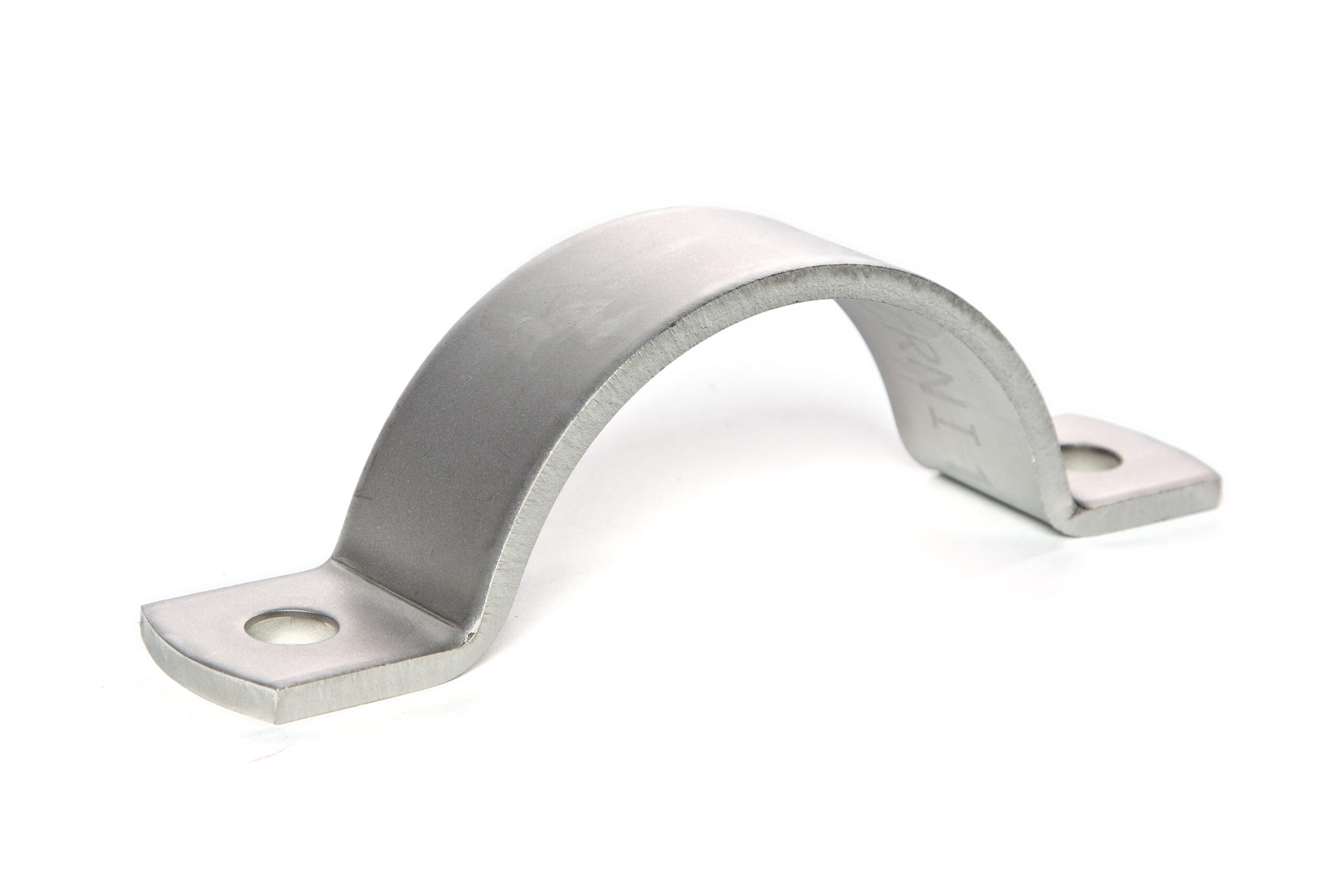
The clamp that saved you four euros costs you four thousand
Procurement teams evaluate pipe clamps on unit price. It is the only number that appears on the requisition. The clamps look identical in the catalogue photograph, the certificates of conformity say "AISI 316", and the imported equivalent is forty percent cheaper than the European-made original.
Six months into the installation, the difference becomes painfully visible. This blog catalogues the five failure modes we have documented across two decades of replacement audits on commodity-clamp installations — and what each failure costs the operator in remediation.
Failure mode 1: Material substitution within "stainless 316"
The marking "AISI 316" on a clamp does not guarantee what is inside it. Several import grades sold as "316" are in fact 316 / 316L / 316Ti blends produced from mill seconds, with carbon content above 0.08% and titanium content highly variable. These materials pass a magnet test and a basic chemistry check but fail at chloride pitting resistance.
The visible consequence in a dairy or beverage plant: clamps develop pinhole pitting at the clamping face within 18-24 months. The corrosion does not perforate the clamp, but the pits collect bacterial residue and become contamination sources on the audited surface.
The recovery cost: full clamp replacement on the affected line, plus revalidation of CIP cycles, plus shutdown for installation. Typical mid-sized dairy line: €18,000-€35,000 plus 36 hours of downtime.
What to ask: EN 10204 3.1 material certificate per batch, traceable to the mill heat number. Commodity suppliers cannot produce this for re-stamped mill seconds. European manufacturers ship it as standard.
Failure mode 2: Wall-thickness drift across the batch
Pipe clamps are specified by strip thickness — typically 25×3 mm or 30×4 mm. Within a single batch from a commodity producer, the actual strip thickness varies by ±0.4 mm because the strip is purchased in mixed-lot stock at the lowest weekly price.
Under the same bolt torque, clamps with thinner strip deform more under load and lose grip force after the first thermal cycle. The pipe slips — not visibly, but enough to disturb the alignment of adjacent supports.
The downstream effect: orbital weld misalignment events on installations that were perfect at FAT.
The recovery cost: re-tightening of every clamp on the line, often during operation, with frequent re-welds at field-weld joints. Typical hundred-support line: €4,000-€8,000 in labour, plus accumulated lost production hours.
What to ask: strip dimensions on the certificate of conformity, with tolerance specified in millimetres rather than as percentage of nominal.
Failure mode 3: Liner material incompatibility
Commodity clamp suppliers often supply with "EPDM liner" without specifying the formulation. The actual liner may be:
- Sponge-EPDM (cellular rubber) — degrades within months under CIP and crumbles into the line.
- General-grade EPDM — survives ambient water but loses durometer at 80°C caustic CIP.
- Recycled NBR labelled as EPDM — fails first contact with caustic and produces sticky residue.
The visible consequence: liner shedding inside the line, causing valve clogging and product contamination events.
The recovery cost: full liner replacement on affected supports, line flush, product recall risk if the shedding has migrated through production. Conservative estimate on a mid-size beverage plant: €25,000-€60,000.
What to ask: liner specification with FDA 21 CFR 177.2600 reference (food), USP Class VI (pharma), durometer (60-80 Shore A), continuous service temperature.
Failure mode 4: Geometric misalignment of the clamping face
We covered this in detail in our Why Perfectly Straight Pipe Clamps Matter blog. The summary: commodity producers do not measure batch-to-batch face parallelism because their press tooling is not specified to control it.
The result: installation labour escalates by 15-25% on prefab and field-weld stages.
The recovery cost: on a typical brewery expansion with 500 supports, €15,000-€40,000 in additional welding labour. This cost is invisible at the time of clamp procurement and shows up as "labour overrun" in the project closeout.
What to ask: specified batch parallelism in millimetres, with reference to the measurement method (calibrated jig or CMM sampling).
Failure mode 5: Bolting hardware downgrade
A clamp set includes the body, the liner and the fasteners. Commodity suppliers ship with mixed-grade fasteners — A2 nuts on A4 bolts, plain washers instead of A4, no lock washers — to hit the headline price.
A2 (304 stainless) fasteners in a 316L application set up galvanic corrosion at the clamping face within months of marine or chloride-rich service. The bolt does not visibly degrade, but the clamping face develops rust streaks that signal the operator to replace the clamp body — when in fact the bolts are at fault.
The recovery cost: full re-bolting of affected supports with matched A4-70 hardware. Typical hundred-support line: €1,500-€3,000 in parts plus 16-24 labour hours.
What to ask: complete fastener spec on the order confirmation: bolt grade (A4-70), nut type (DIN 985 nylock), washer grade (A4), per-clamp piece count.
What to do about it
The five failure modes above share a common feature: each is detectable at the time of order placement if you ask the right question. They are invisible if you accept the bid sheet at face value.
For NIBRO-supplied clamps, the answers are documented as standard:
- Material per EN 10204 3.1 with mill heat traceability
- Strip dimensions specified in mm with measured tolerance
- Liner per FDA / USP Class VI / EPDM 70 Shore A
- Batch parallelism documented per production lot
- Complete A4-70 fastener kit with lock-nuts and matched washers
The unit-price premium over commodity imports is two to four euros per clamp at the standard range, and ten to fifteen euros at the heavy DIN 3567 range. The recovered cost across the five failure modes above is conservatively one to two orders of magnitude higher across the lifetime of an installation.
Conclusion
Cheap pipe clamps are not actually cheap. They redistribute cost from the procurement budget to the maintenance budget, to the welding budget, to the product-recall budget, and ultimately to operating margin. The five failure modes documented here are not edge cases — we see at least three of them on every commodity-clamp installation we audit. Specifying European-manufactured clamps with documented material, dimensional, liner and fastener controls eliminates them at source.
Take this article into your next project meeting
Download the full NIBRO-branded whitepaper PDF — printable, A4, with QR back-link.