
The labour cost nobody itemises
In any stainless installation budget, "pipe support hardware" appears as a single line item with a cost of a few thousand euros. "Pipe support labour" never appears anywhere. It is buried inside welding labour, inside fitter labour, inside project overhead.
This is convenient for the contractor and expensive for the operator. The installation labour associated with pipe supports is in fact between 30 and 60 percent of total installation labour on a typical prefab project, and clamp design choices made at procurement determine which side of that range your project lands on.
This blog quantifies the labour-cost mechanics behind clamp choice and explains the four design features that drive the difference.
The four labour-consuming steps in a clamp installation
Walk a prefab shop floor and watch what happens when an installer fits a pipe spool to a support beam. There are four discrete labour steps:
- Position the clamp on the beam. The mounting plate or U-bolt is offered up, the spacing marked, the holes drilled or the weld tacked.
- Align the pipe to the clamp. The pipe is lifted into the open clamp, rotated to the correct orientation, and held in place.
- Tighten the clamp. Bolts are torqued, lock-nuts engaged.
- Correct misalignment. Where the pipe does not sit square in the clamp, shims are added, the clamp is loosened and re-tightened, or the support is moved.
Step 4 is the variable cost. On commodity-clamp installations it consumes 25-40% of total clamp-installation time. On precision-clamp installations it consumes 5-10%. The cause is clamp geometry.
Why precision clamps eliminate step 4
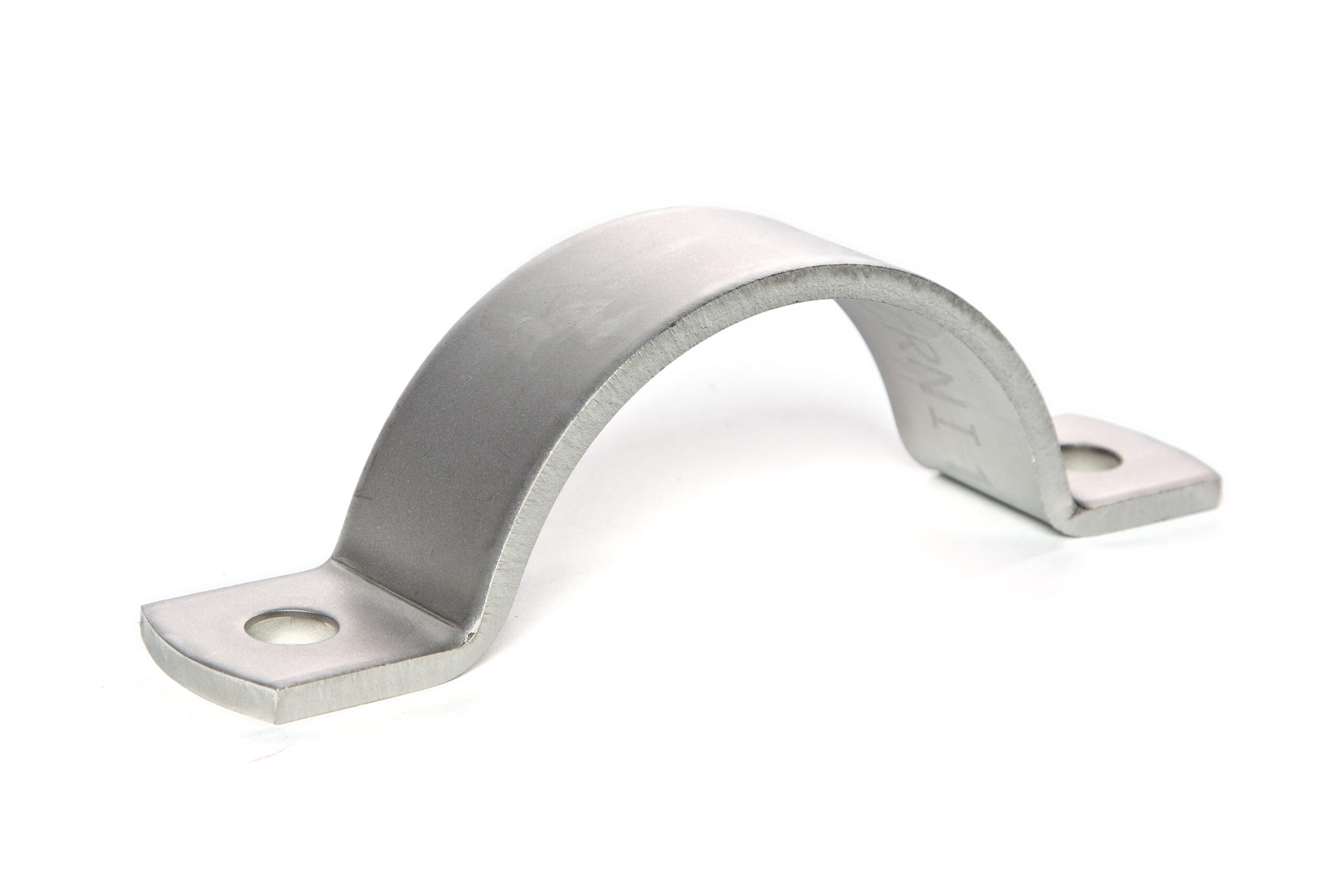
The double-bent NIBRO profile delivers three geometric properties that make step 4 unnecessary on the vast majority of supports:
Parallel clamping faces. The pipe drops into the clamp and rests on a face that is square to the mounting plane. No rotation, no shimming.
Concentric inner radius. The pipe centreline aligns with the bolt centreline. Tightening pulls the pipe straight, not sideways.
Constant strip thickness across the batch. Every clamp on the line presents the same gripping geometry under the same torque. No compensation for "this clamp grips harder than that one".
The cumulative effect across a hundred-support installation is a measurable reduction in total clamp-installation time. Independent prefab-shop time studies show 20-25% labour savings on stainless installation projects when commodity clamps are replaced with precision European stock.
Where the savings compound: orbital welding
The labour savings above are visible at the clamp itself. There is a second-order effect that compounds the saving: every clamp installed straight is one less orbital weld that requires intervention.
We covered orbital weld defect modes in our pipe clamps and orbital welding quality blog. The summary for productivity purposes: an orbital weld that passes first time consumes 90 seconds of operator time. An orbital weld that requires intervention (re-tack, parameter adjustment, hand-finish) consumes four to seven minutes.
On a 200-joint installation with commodity clamps, expect 15-25 interventions. The same installation with precision clamps typically sees 2-5 interventions. That is approximately one hour of saved orbital welding time per 100 joints, on top of the clamp-installation labour saving.
What the math looks like on a real project
For a typical hygienic stainless installation:
- 200 supports total
- 400 orbital welds (2 per support on average)
- 3 installer-hours per 10 supports with precision clamps → 60 hours
- 4 installer-hours per 10 supports with commodity clamps → 80 hours
- 1.5 minutes per orbital weld with precision clamps → 10 hours
- 2.2 minutes per orbital weld with commodity clamps → 14.6 hours
Labour difference: 24.6 hours in favour of precision clamps.
At an EU prefab-shop labour rate of €65/hour (engineer + apprentice blended), that is approximately €1,600 in saved labour on a project that uses 200 supports. The clamp price difference — €2-4 per piece × 200 = €400-800 — is recovered three to four times over from labour savings alone.
For larger installations the figures scale linearly. A brewery expansion with 800 supports recovers €6,000-€8,000. A pharmaceutical greenfield with 1,500 supports recovers €12,000-€20,000.
Design features that drive the saving
Procurement specifications that capture these savings include:
- Maximum batch face parallelism ≤ 0.5 mm, verified per production lot
- Concentricity of clamp inner radius to bolt centreline ≤ 0.2 mm
- Strip thickness tolerance ±0.1 mm (not ±10% of nominal)
- Complete fastener kit included, eliminating shop-floor sourcing of A4-70 bolts
- Pre-bagged clamp sets with body + liner + fasteners in a single pack, reducing fitter time hunting for components
NIBRO ships against these specifications as standard. Commodity producers ship against price; the specifications are negotiable on request, usually with lead-time penalty.
The OEM and prefab perspective
For OEM machine builders and skid fabricators, the labour saving is not a budget item — it is throughput. A skid line that completes a 200-support module in 65 hours instead of 90 hours releases the same shop space and the same crew to start the next module sooner.
OEMs we serve on a partnership basis report that the productivity improvement from switching to NIBRO clamps was sufficient to justify the price premium before the secondary benefits of better quality, lower reject rate and fewer field-weld interventions were counted.
Conclusion
Pipe-clamp installation labour is the invisible majority of pipe-support cost. Commodity clamps push that labour up by 20-25% because their geometric tolerances are not controlled to eliminate misalignment correction. Precision clamps eliminate the correction step at source. The economics favour precision clamps on any installation above approximately fifty supports — and on every installation that uses orbital welding.
Take this article into your next project meeting
Download the full NIBRO-branded whitepaper PDF — printable, A4, with QR back-link.